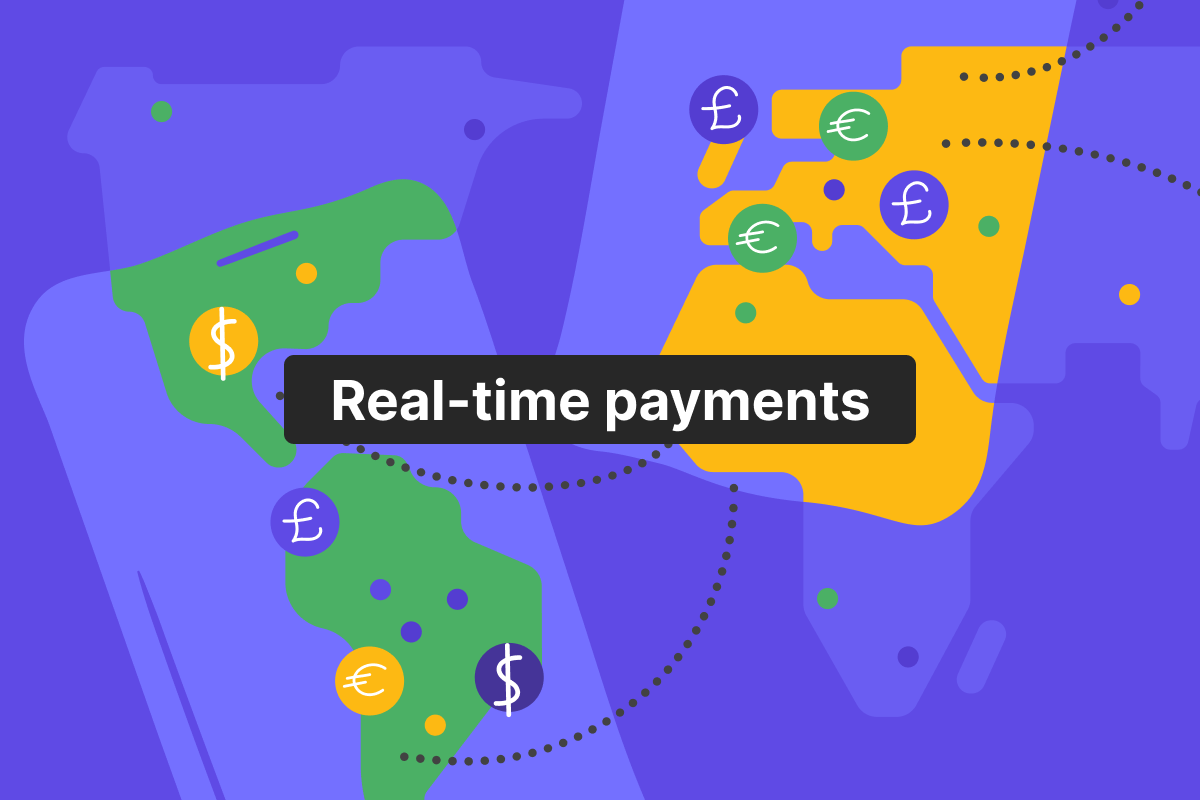
Instant payments are real-time payments that let you send money immediately. It ensures good cash flow and avoids the problems associated with delays. We’ll be looking at how real transactions work and the benefits they offer.
Real-time payments explained
What are real-time payments, and how do they help your business? The emergence of real-time payments has changed the way we handle financial transactions. While it once took a long time for payments to land in a bank account, immediate payments now ensure a rapid, seamless payment process.
They’re processed immediately, which is a significant change from the past. Previously, a payment service like ACH would be processed in batches during a window at a certain time of day, leading to payment delays.
Now, faster payments are initiated at any time of day, provided that there are sufficient funds in the sending account. Just as importantly, the payment system provides instant settlement and immediate confirmation. There is no waiting period where the transaction is shown as pending, but the funds can’t yet be accessed.
Finally, you can send and receive funds instantly at any time of day. With 24/7 availability, you aren’t tied to the concept of business days and banking hours when transferring funds.
Open an account
in Genome online
How real-time payments work
Now that you’ve seen real-time payments explained, there are several points to take into account here that explain how real-time payments technology works.
Bank-to-bank. It isn’t simply a faster version of older transfer systems. It’s a new payment system built on an account-to-account (A2A) approach. Money goes directly from one bank account to another.
Settlement mechanism. The use of real-time gross settlement (RTGS) ensures that settlement is instant on the books of the banks and financial authorities. It means that the right amount is moved when the payer initiates a payment.
Clearing in seconds. The money moves from the sender’s account to the receiving account in seconds. Validation, messaging, and acceptance are all carried out immediately.
A2A payments architecture. The real-time payments banking infrastructure has been designed to allow instant transfers where the money doesn’t need to pass through another account on the way.
API confirmation. The application programming interface (API) is another vital element that permits immediate payment. API integration gives bidirectional flow with instant feedback. See the Pay by Bank process explained here.
What are the benefits of real-time payments?
There are several key benefits to real-time payments that make it a sensible choice of transfer method.
Speed. The biggest benefit of real-time payment systems is that the money arrives right away. It makes cash flow management easier and removes any worrying delays.
Instant confirmation. By receiving instant confirmation, both the sender and the receiver know the transfer went through without any problems.
Fewer intermediaries. It is a direct payment system that removes the need to rely on intermediaries, giving a faster transfer with no processing delays or manual intervention.
Lower cost. The fact that this is a more cost-effective payment type is another major benefit. Money can be sent cheaply in just a few seconds and all year round.
Higher efficiency. It is more efficient than other payment methods. The customer experience is enhanced as real-time transactions take away the delays and concerns that used to exist with transfers.
Faster settlement. With real-time payment networks, it’s not just about the money moving more quickly. The electronic payments are also settled immediately, making it easy for the recipient to start using the funds.
Real-time notifications. The next benefit of real-time payments is that you’re always informed about what is happening. There’s no risk of waiting around and worrying, in the way that a wire transfer or cross-border payments could be. Instant notifications ensure that you know exactly when the money moves.
24/7 availability. This crucial aspect means that you don’t need to wait to make a payment. While most banks have restrictive working hours, online payments are always available.
Better cashflow. Whether you work for a large company, a startup, or in the gig economy, good cash flow is vital. This way to send and receive payments instantly makes it easy to move money at the right time.
Reduced operational delays. RTP payments don’t run into any of the delays that could cause problems with traditional transfers. The cash moves from the sender’s bank instantly and without any need for manual intervention.
Fewer reversed payments. This slick and seamless payment transfer process means that far more transfers go through without any issues. So there’s no need for reversed payments or to resolve errors.
Use cases of real-time payments
By looking at some examples, we can see how the real-time payment process is helping different sectors to work more effectively.
Ecommerce. By integrating real-time payments, the checkout process becomes faster and easier. It means the merchant doesn’t have to wait for a pending payment to clear and reach their bank account. It can also help lower cart abandonment rates and save money on card network fees. Find out what a merchant account is and how you can use our services for a smoother process.
Digital services. This industry uses RTP transfers for a smooth process that fits the forward-looking service it provides.
Payroll. Gig workers and remote employees are among the staff who can get paid instantly now, thanks to real-time payment methods.
P2P transfers. Sending peer-to-peer transfers is the clearest use case for most consumers. This is a simple and effective way to send instant payments to anyone without intermediaries like financial institutions.
Cross-border settlements. One of the biggest changes can be seen in international account transfers. These were once lengthy and complicated, but instant cross-border transfers now make it much easier.
Subscription billing. Expired cards and failed payments are common problems in subscription payments. Using direct payments from accounts reduces the business’s churn risk.
Real-time payments vs traditional bank transfers
The early days of traditional bank transfers were complicated. When we compare this type of transaction to a modern payment made directly to an account number, we can see the benefits introduced.
The most notable difference is the speed of the transfer and settlement. With instant payments, there is no longer any need to wait for the clearing house to process payments.
24/7 availability is another big difference with real-time payment networks. There’s now no need to wait for business days or bank opening hours to send a transfer. It can be done at any time from mobile wallets using Open Banking.
Fees are also lower with this type of RTP payment. The transaction goes through without intermediaries, which helps reduce costs and improve speed. There is no clearing house delay with settlement or batch transfers, which is why these instant payments appear immediately in the receiving account.
Real-time payments vs card payments
If we compare instant payments made in real time to card payments, we can see several key differences.
Interchange fees and processing fees. The presence of card issuers and networks means that fees need to be paid to them. However, direct real-time payments avoid this problem.
Settlement time. Both these transaction types appear instant to the customer. However, the card payment doesn’t settle right away, while a real-time payment moves the cash instantly.
Fraud risk. Card payments present the risk of chargeback fraud or of stolen cards being used to make fraudulent payments. With strong customer authentication, this risk isn’t an issue with instant RTP transfers.
Real-time payments in Europe
The name SEPA Instant is used to refer to instant payments in Europe. It is a secure way to use real-time payment networks to send funds in euros across the EU.
These instant bank transfers are closely regulated. The financial institutions using them need to follow a strict set of rules at all times under the SEPA Instant Credit Transfer (SCT Inst) scheme.
Real-time banking systems around the world
As we look around the planet, we see other ways that global financial institutions are able to send instant payments.
RTP (US). It is the Clearing House network that is owned by some of the largest North American banks.
FedNow. This is the network run by the Federal Reserve. It gives instant settlement access to all banks and financial institutions, but is run by the Federal Reserve.
SEPA Instant. The pan-European standard applies to Eurozone countries and requires all banks in the region to offer instant payments and SEPA transfers at the same cost.
Faster Payments UK. Most mobile banking and internet banking in the UK is covered by this process, which settles transfers instantly.
Open an account
in Genome online
How Genome supports real-time payments
Genome gives your business a way to seamlessly accept A2A payments with real-time settlement in euros via our instant bank payments. The SEPA Instant process is used in the Eurozone, giving you a convenient and low-cost alternative to card payments.
Not only that, but we also offer instant business transfers. With them, you can make sure that your funds are always where they need to be, allowing easy cash flow and reconciliation. Our online account-opening process means you will have your business account and merchant account ready to use with ease.