

How do you set up your payment infrastructure in Europe today? Is it already a single economic entity, or will it be in the future? Which currencies to use? How strict are the regulations? Our team will explain how it all works and how to accept card payments on your website.
There are currently many payment methods across the EU that people use – digital wallets and direct bank transfers are rapidly growing as an alternative to card payments. Card networks Visa and Mastercard are holding nearly half of European payments, and the digital Euro – an EU competitor in this niche – is coming.
How do you navigate this space, and what should you prioritize first, especially if you are new to the market?
This step-by-step guide is from a payment provider perspective and outlines how to build the right infrastructure to accept card payments online in the EU.
Step 1: Choose the right payment model and merchant account
To process credit and debit card transactions on your site, you need a structured system to authorize, collect, and transfer customer funds. It works for any payment method. Wallets, crypto, etc., won’t magically transact from one account to another.
This is why payment providers exist – merchants don’t gain licenses and configure Visa, Mastercard, SEPA, by themselves. The payment provider you choose has already done this job.
Today, merchants generally choose between two primary operational setups: acquiring a dedicated merchant account or partnering with an all-in-one payment service provider (PSP).
Important note: a merchant account is a specialized financial account where funds from card payments are temporarily held before being settled directly into your primary business bank account.
So, what is the difference between a PSP and a dedicated merchant account in Europe?
PSPs are usually very fast to set up, they have a flat-rate fee, but you won’t get your own merchant ID. Because PSP models act as an aggregator, they manage thousands of merchants under one master account.
Such a payment service provider is often a good starting point for a business.
Large and medium-sized companies tend to move toward a dedicated merchant account in Europe.
The reasons:
Custom pricing structures: A dedicated account isn’t just a name. It’s the tool to set lower interchange fees for higher-volume merchants, unlike with most PSPs, which offer a flat-rate model. The more transactions you have, the more viable dedicated accounts become.
Greater settlement flexibility: You retain full control over payout frequency, payout threshold settings, and multi-currency holding accounts, which are benefits in their own right and deserve attention.
Higher operational stability: Aggregate accounts carry a higher risk of sudden hold measures or transaction freezes during volume spikes – as we mentioned before, this is not your account exclusively but one of the many under the master account.
And here’s why a dedicated merchant account in Europe is specific: you need a business account with a dedicated IBAN. This is essential for legal reasons and for the technical ability to segregate incoming funds. It’s also a must-have for dashboard management.
Open an account
in Genome online
Step 2: Select an online payment gateway for Europe
A merchant account provides the destination where clients send their money. Still, the payment gateway is the hardware and software that makes it possible. It’s like a digital conduit that connects your e-commerce website to the processing network.
The gateway captures sensitive customer payment details, encrypts the data, routes it to the issuing bank for authorization, and returns the approval or decline.
An online payment gateway in Europe would be specific due to regulations that require that data of European customers stays in Europe – it’s called GDPR.
When you choose a payment provider, you should consider this:
Hosted checkout pages: The shopper is seamlessly redirected to a secure, third-party payment page hosted by your processing partner. This model significantly reduces your PCI compliance obligations by shifting them to the provider’s side.
Custom API integrations: The entire checkout is built custom from the ground up via developer APIs. This offers complete UI control and custom user flows, but requires strong security oversight and technical development on the company’s side.
Embedded checkout forms: It’s a middle ground between a hosted payment page (fully third-party solution) and API integration (when you have full control). In this scenario, you integrate only the provider’s payment fields directly onto your checkout page via iframes (Inline Frames). The difference is that you can keep your unique brand style while the payment provider handles the security.
Lifecycle stage | Action | Primary function & business value |
1. Customer checkout | Customer enters card details | Initiates transaction at online checkout |
2. Gateway transmission | Online payment gateway Europe encrypts data | Safely routes sensitive card payload to payment networks |
3. Authorization request | Card network & issuing bank evaluate | Checks available funds, risk level, and 3D Secure 2.0 compliance |
4. Approval status | Authorization granted or declined | Sends instantaneous approval or decline decision back to merchant site |
5. Settlement payout | Funds settle into merchant account Europe | Payout transferred directly to main business account balance |
For businesses that serve customers outside the Eurozone, multi-currency card acquiring is critical.
Not every country in Europe has adopted the euro (Poland, Sweden, Denmark, for example). Still, showing potential customers prices in their local currency can eliminate unexpected foreign exchange fees on their end. If you also add clear delivery prices and terms, you can improve the checkout conversion rate.
Step 3: Ensure regulatory and security compliance
Each jurisdiction has its own rules and current agenda, and you should take it into account. The European Union currently focuses on financial regulations designed to combat online fraud, money laundering, and protect consumer financial privacy and data.
Non-compliance can result in heavy financial penalties, elevated chargeback rates, and blocked transactions from card-issuing banks.
Merchants accepting online card payments across the EU must maintain three core security standards:
3D Secure 2.0 compliance
Under the European Union’s Revised Payment Services Directive (PSD2), Strong Customer Authentication (SCA) is mandatory for electronic payments.
In simple terms, transactions should be authenticated using 2 factors – password, biometric fingerprint, SMS, etc.
Sounds serious, but many banks and payment providers have already implemented this in banking apps. You can’t authorize payments without a fingerprint or password.
Modern 3D Secure 2.0 compliance protocols incorporate background data-sharing between the merchant and issuing bank to analyze risk in real time.
Low-risk transactions have advantages – the payment provider can qualify them for frictionless authentication exemptions, meaning no need for a PIN code, which slightly boosts checkout conversion rate.
PCI DSS certification
The Payment Card Industry Data Security Standard (PCI DSS) governs how credit card details are transmitted, processed, and stored.
It’s a technical requirement for bank developers.
What you should know: using hosted payment gateways or secure iframe fields offloads most of the legal burden to your provider.
GDPR compliance
European privacy law requires clear consent and secure handling whenever you collect personal identification and billing data.
In short: European data should stay in Europe. That is why European payment providers have become more mainstream in recent years.
Step 4: Combine card processing with local payment options
Although Visa and Mastercard hold a huge share of the European payment market, relying exclusively on card networks will cause you to lose significant sales volume across Europe.
European payment habits are fragmented – many people are starting to use SEPA and digital wallets as an alternative to card payments, and before the Digital Euro launches, there will be some time to pass.
Currently, the EU has a very diverse mix of payment preferences, with a strong tendency to change in a few years. At the moment, the best strategy is to maximize reach across different European territories, pair your card payment processing with local alternatives, and the Pay by Bank options:
Country / Region | Local preferred payment method | Consumer habit & payment flow |
Netherlands | iDEAL | Overwhelmingly preferred online option; direct bank redirect via online banking app. |
Belgium | Bancontact | Dominant local card and QR-code payment standard for both online and physical retail. |
Poland | BLIK | Mobile-centric payment system using six-digit one-time authorization codes. |
Germany / DACH | Open Banking & BNPL | Security-focused region preferring invoice options, Klarna, and bank transfers. |
Europe-wide | SEPA payment gateway | Instant account-to-account payments using standardized European IBAN transfers. |
Integrating a direct SEPA payment gateway alongside traditional card acquiring is currently the way to go in Europe.
SEPA is a euro-exclusive system, but it’s cheaper than regular card payments. Open Banking is also on the rise because it offers a smooth transaction experience (instant payments). There are no card-related chargebacks if you are using instant payments.
Don’t forget mobile wallets like Apple Pay and Google Pay – they are popular mainstream payment tools and will likely remain in use longer than Visa and Mastercard in Europe.
Step 5: Integrate, test, and launch your checkout
Technical deployment will start after you have chosen a payment provider with the right merchant infrastructure (account) and payment gateway – in an ideal world, it should be a single entity.
Most modern payment platforms offer turnkey plugins for major e-commerce platforms like WooCommerce, PrestaShop, Shopify, and Magento, plus REST APIs and SDKs for custom-coded websites.
If you’re not sure how to work with or integrate these tools, consult every move with your developer team.
Before going live with real transactions, complete this deployment checklist:
Conduct end-to-end sandbox testing: Execute simulated purchases using test card numbers to confirm successful payment flows, automatic receipt generation, and backend order updates.
Test intentional failure states: Verify how your website’s checkout responds to declined transactions, especially incorrect CVVs or expired cards. This helps you clearly see the problem and, so to speak, establish what failure looks like for your team.
Check mobile responsiveness: Mobile devices should be a high priority. First, they are a huge chunk of your audience, and second – this is the most potentially problematic field – confirm that card input fields work, that the UI allows you to see everything clearly, security pop-ups really pop up, and all of this works across all device screen sizes and operating systems.
Validate 3DS2 authentication prompts: Ensure bank verification windows display correctly and process exemptions without hanging or dropping session data.
Confirm currency conversion rules: Test multi-currency card transactions to ensure your multi-currency card acquiring configuration routes foreign sales to the correct EUR, GBP, or USD balance sub-accounts.
Streamline your payment setup with Genome merchant services
Managing separate bank accounts, payment gateway providers, and regional acquirers can quickly become an operational headache for growing businesses. Genome merchant services simplify the process for you, offering all the main merchant tools you need and developing more as we grow!
Through Genome, digital businesses gain access to dedicated business IBAN accounts, merchant services, and Open Banking payment tools, all managed within a unified financial platform.
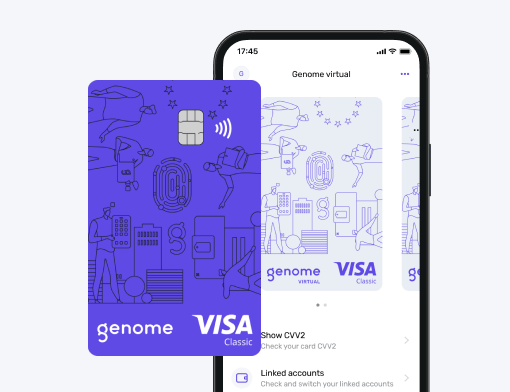
Genome is also entering its next major milestone: Genome card payment processing is coming soon.
This major release will bring Visa and Mastercard card acquiring capabilities straight into your main Genome platform, allowing you to accept card payments online EU-wide alongside the existing instant bank payments (Pay by Bank) tools for accepting customer payments.
With the launch of Genome card payment processing, merchants gain access to:
Visa and Mastercard acquiring: Process online card transactions globally with high authorization rates and transparent reporting.
Unified account management: Manage incoming card revenue, bank transfers, and payouts within a single, dedicated merchant account within Europe.
Multi-currency capabilities: You will be able to settle card payouts into dedicated EUR, USD, and GBP accounts.
Flexible technical integration: Deploy secure, hosted payment pages with fast setup and minimal development overhead.
Open an account
in Genome online
Final thoughts
Learning how to accept card payments on your website is the foundation for e-commerce growth across the European Union. By selecting an optimized acquiring partner, maintaining strict 3D Secure 2.0 compliance, and offering local alternative payment methods alongside global card schemes, you can create a high-converting, friction-free purchasing experience for shoppers across every border.
With Genome merchant services and the upcoming launch of Genome card payment processing, unifying your business accounts, direct transfers, and card acquiring under one roof has never been easier. Prepare your online store today to capture every growth opportunity across Europe.