

Have you heard stories about frozen accounts and financial penalties when your chargeback mitigation wasn’t successful?
Getting your business labeled as “high-risk” by a bank or financial institution is inconvenient to say the least. Risk and underwriting teams assess your industry, business model, chargeback history, fraud exposure, processing volume, geography, and other risk factors before making that call. The label does not automatically say anything about your business ethics, your product quality, or whether you’re actually doing anything wrong.
The real problem isn’t the label. It’s what happens when you ignore it.
High-risk industries are somewhat unique. Some merchants sign up with standard payment processors every year, operate for weeks or months without issue, then get reclassified, reviewed, or restricted once chargeback levels, fraud indicators, or compliance concerns appear.
The business keeps running, the chargebacks keep coming, and suddenly, settlements may be delayed, funds may be held in reserve, the account may be reviewed, or card scheme penalties may apply if thresholds are exceeded.
Our team will explain what you can do, how to choose a provider, chargeback mitigation strategies, and why a high-risk merchant account may be a good fit for you.
What classifies a business as “high-risk” in 2026?
Banks and payment processors categorize merchants based on a number of reasons, but chargebacks are usually one of the main drivers. If your industry has historically high dispute rates – either because customers change their minds, fraud occurred, or because the regulatory environment is strict – the payment provider may price that risk into fees, reserves, settlement terms, and account conditions.
In 2026, the high-risk industries list looks roughly the same as it has for a decade, with maybe a few additions. Keep in mind that every payment provider uses its own underwriting criteria:
Gambling: iGaming, online casinos, and sports betting, etc, are regulated differently in every jurisdiction, usually have high transaction volumes, and a specific customer base that disputes charges.
Crypto exchanges and Forex trading – volatile, have a huge currency variety, and are under heavy regulatory scrutiny in the EU and the US.
Subscription and SaaS businesses – recurring billing with long refund windows pose a structural chargeback risk. Negative option billing is especially sensitive because unclear trial or renewal terms can lead to recurring payment disputes.
Travel and ticketing – there’s often a long gap between payment and service delivery, which creates dispute windows that can stretch for months.
Nutraceuticals, CBD, and supplements – regulatory grey zones and efficacy disputes drive chargebacks and doubts from the payment provider side due to reputation.
Adult content and dating platforms – age verification complexity, high fraud rates, and reputational risk for processors.
Luxury goods and high-value transactions – a single chargeback on a €9,000 order stings differently than one on a €30 item. Plus, the industry can be used for money laundering and potentially drive attention from authorities.
At the same time, you don’t have to be in one of these industries to be classified as high-risk. Each payment provider has its own classification. A 1% chargeback ratio is often treated as a warning benchmark, but the thresholds vary by network, region, transaction volume, and monitoring program.
Open an account
in Genome online
The setup and underwriting process for high-risk merchants
High-risk merchant account underwriting is methodical, document-heavy, and can be slower.
That’s not a flaw. Merchant account underwriting that cuts corners on KYB, KYC, ownership checks, and business risk review may approve merchants faster at first, but it can also lead to later restrictions, reserve requirements, additional checks, or account termination when the actual risk picture becomes clear.
Documents you will usually need:
Identity verification of the director or person appointed by them (passports or government ID for directors).
After you provide your personal information, you will usually be asked to add and verify your phone number and email (your personal, not the company’s).
The next step is to submit your business registration details (company name, registration number, company email address, and company phone number).
After that, you will be asked to submit your company’s financial information (bank statement). It will usually include 3–6 months of prior processing history.
The next steps are the company’s registered address with the government body, tax residency information, and the company’s ownership structure, if relevant to you.
Also, in some cases, you will need to provide a clearly written refund and cancellation policy, visible on your website.
The last one matters more than people expect. Underwriters in 2026 will look at your website the same way a skeptical customer would look.
If your refund policy is buried in a footer link that goes nowhere, that’s a red flag. If your domain was registered two weeks ago, that can also be an issue. A clean processing history and a transparent customer-facing policy can meaningfully accelerate your approval.
If you’re starting fresh with no processing history, a clear business plan, and a well-documented operational structure is a substitute for those. The underwriter is trying to answer the following questions: Is this business legitimate? Is it compliant? Can it manage refunds, chargebacks, fraud, and delivery obligations?
Payment processing: How high-risk differs from low-risk
In general, three things will look different on your contract: reserves, fees, and volume caps.
Rolling reserves are the one that surprises people most. Rolling reserves mean the processor withholds a percentage – typically 5–15%, depending on the business, provider, and risk profile – of every transaction for a set period, often 90–180 days, and then releases those funds on a rolling basis. It is a buffer against chargebacks, refunds, fraud, and other liabilities that may arise after funds have already been settled.
The important framing here: the money is still yours. It is not a fee. But it does affect cash flow, especially in the early months of a new processing relationship. A merchant processing €100,000/month at a 10% rolling reserve has €10,000 withheld each month. With a 90-day reserve period, this can mean around €30,000 temporarily held once the reserve is fully built, before older reserve amounts start cycling back. Plan your working capital around it.
Processing fees for high-risk merchant accounts sit higher than standard rates. The exact rate depends on the provider, industry, payment method, geography, transaction volume, chargeback exposure, and compliance profile. The spread reflects higher underwriting, monitoring, fraud, and dispute-management costs. It is not a punishment; it is risk-based pricing.
Volume caps are common in the first months of a new account. Processors will often set a monthly limit – for example, €50,000 – while they observe your actual chargeback rate, fraud prevention performance, refund behavior, and processing stability.
As you demonstrate stability, those caps may increase.
You can refer to Genome’s transparent pricing to see the difference between high- and low-risk fees, which will give you an idea of what to expect.
Security and chargeback mitigation strategies
For years, Visa and Mastercard have operated chargeback and fraud monitoring programs that every high-risk merchant should understand. The old “1% chargeback threshold” is still a useful warning benchmark, but should not be treated as a universal 2026 rule. You need to remember that Visa and Mastercard use different monitoring formulas, thresholds, monthly counts, and escalation rules. Breach the relevant threshold for your card network, region, and volume, and you may enter a formal monitoring or remediation process.
Stay there long enough, and you can face fines, stricter controls, account termination, or loss of card acceptance. In serious cases, a terminated merchant may also be reported to Mastercard’s MATCH list, which can make finding a new processor significantly harder.
The fraud prevention toolkit that matters in 2026 to reduce chargebacks:
3D Secure 2.0 – For many online card merchants, especially in high-risk sectors, 3DS2 is close to essential. The liability shift is the key mechanic here. When a card issuer authenticates a transaction through 3DS2, liability for certain fraud-related chargebacks may move from the merchant to the issuer, depending on scheme rules, region, transaction type, and authentication result.
Tokenization – storing a secure token rather than raw card data reduces breach exposure and limits the fraud surface area.
Device fingerprinting – tracking the device profile behind a transaction catches scenarios that card data alone will not. A single bad actor or coordinated fraud pattern can trigger enough chargebacks to put the account under review.
Dynamic risk scoring – real-time risk evaluation at the point of transaction, adjusting friction by requiring 3DS, flagging for manual review, or blocking suspicious attempts based on the risk signals of each individual transaction rather than blanket rules.
The whole package can strengthen your high-risk payment processing setup, but it does not make a business immune to chargebacks.
Alternative payment methods deserve a mention here because they can reduce reliance on card rails. Open Banking payments, account-to-account/A2A transfers, and instant transfers such as SEPA Instant or Faster Payments do not run through card networks, which means card-based chargeback mechanisms do not apply. SEPA Instant is a credit transfer scheme where funds are made available in under ten seconds, while the UK Faster Payment System supports real-time bank payments day and night.
For merchants in certain high-risk industries, routing part of transaction volume through bank transfer rails can meaningfully reduce card-dispute exposure.
Secure your high-risk operations with Genome
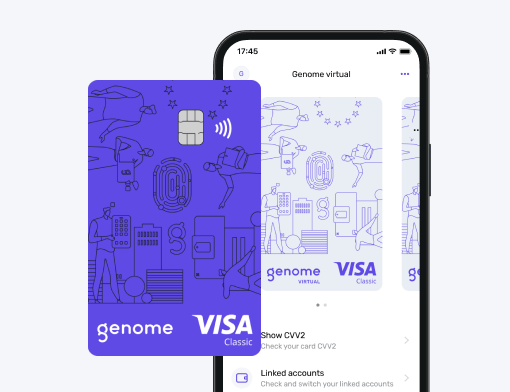
Genome merchant services are advanced and tailor-made for companies across many industries, including approved businesses in some high-risk sectors.
Apply for a business wallet to unlock multi-currency accounts in EUR, USD, GBP, PLN, CHF, JPY, CAD, CZK, HUF, SEK, AUD, and DKK, as well as dedicated EUR IBANs.
Once it is done, apply for our merchant account! Currently, we offer instant bank payments, which allow you to accept payments from customers via Pay by Bank payment methods. SEPA Instant and SEPA Credit Transfers are used for these account-to-account payments, helping merchants receive funds faster and reduce reliance on card networks.
Our Open Banking-powered instant bank payments give high-risk merchants a path to accept payments that bypasses card networks entirely: no card-based chargebacks, faster settlement when SEPA Instant Transfers are used, and lower dispute overhead compared with card payments.
Card payment processing will be available inside Genome soon as well. Merchants will be able to accept online Visa and Mastercard payments and settle card revenues into selected EUR, USD, or GBP business accounts. Genome’s card processing setup also includes hosted payment pages, next-business-day settlement in many cases, 3D Secure, and fraud prevention tools. Not to mention, merchants can always use Open Banking as a backup payment method when a card payment fails. It can help merchants improve approval rates, reduce abandoned checkouts, and keep more payments moving through one connected merchant setup.
Open an account
in Genome online
Conclusion
Operating a high-risk business in 2026 does not have to be complicated if your payment infrastructure matches your actual risk profile. Merchants that face frozen accounts, delayed settlements, or long reserve holds often have one thing in common: they started with a processor that was not built to support their industry and only discovered the mismatch once problems appeared.
In some cases, the issue is also a lack of transparency during onboarding. A business may present its model too optimistically, leave out important operational details, or underestimate its chargeback and compliance exposure. But in high-risk payment processing, clarity from the start matters.
Setting up a proper high-risk merchant account requires more work up front. The fees can be higher, and underwriting may take longer, but the structure is designed for businesses with larger volumes, stricter compliance needs, and higher dispute exposure. It is not just about paying more – it is about working with infrastructure that understands your business model.
If you are ready to choose a setup built for your industry with high-risk payment processing included, Genome merchant services is a notable place to start.