

Here’s something nobody tells you before you launch: getting paid for your product or service is sometimes harder than getting customers.
You’ve built the product. You’ve got people interested. Then you try to set up a merchant account through a traditional bank, and suddenly you’re being asked for three years of audited financials, an in-person appointment at a branch that’s only open on Tuesdays, and a six-week underwriting review – for a business that’s been live for four months.
The client’s side of the story is also complicated. A 2025 survey of merchants in the UK shows that payment method usage is highly diverse, with only cryptocurrency remaining a niche, while direct bank transfers, Buy Now Pay Later, and digital/mobile wallets are widely used. The interest in Open Banking is growing, though adoption still trails more established methods.
Issues with the checkout experience directly correlate with cart abandonment rate, but it’s serviceable.
According to the report, with almost half of surveyed merchants reporting abandonment rates above 20%, improving the payment experience is a major opportunity to recover lost revenue across most businesses in the study.
However, that’s not what people expect when seeking an answer to the question “How to open a merchant account for startups”. And it’s completely avoidable in 2026, if you know where to look.
A merchant account is the financial infrastructure that lets your business accept card payments, authorize various transactions, and receive settled funds. It is essential for online payment processing.
But for a modern startup, especially one with global customers, multi-currency revenue, or a subscription billing model, that basic definition barely scratches the surface of what you actually need. You need settlement speed. You need currency flexibility. You need compliance built in.
This guide walks through how to open a merchant account for startups without the headaches, and why the approach you choose matters more than most founders realize.
Open an account
in Genome online
Why traditional merchant accounts fail startups
Dealing with a legacy bank is not always easy. Here’s a scenario: you fill out a lengthy application. Someone calls to ask for documents you already uploaded. Weeks pass. An underwriter who may be less familiar with SaaS recurring revenue or digital goods decides your business model is “unusual” and asks for more paperwork. More weeks pass. You either get approved with conditions that make no sense for your cash flow, or you get declined with a form letter that tells you nothing useful.
A scenario like this can happen when you deal with a regular traditional bank. It hurts startups, and it is even harder for businesses considered high-risk.
The problem is often in risk and compliance processes- and the systems they rely on. Traditional merchant accounts and their underwriting playbooks were built to assess more predictable, well-documented businesses. A bakery. A garage. A clothing boutique. The underwriting models, fee structures, and settlement cycles were often shaped with that world in mind. When a fintech startup processing payments in four currencies across twelve countries walks through the door, the system may struggle to assess them quickly.
Modern payment providers like Genome were not created just because. We offer a fintech-first approach. Online onboarding instead of branch visits. Automated KYC and KYB instead of manual document reviews. Integrated financial systems instead of standalone payment rails bolted onto a current account you barely use. Pay by Bank solution (Open Banking for merchants), multi-currency business wallet, easy online payment processing, etc.
Low-risk vs. high-risk merchant accounts
A note on the classification of low-risk vs. high-risk merchant accounts. The real issue is that not every payment provider is willing to work with high-risk businesses, as they have more risks associated with them. High-risk doesn’t automatically mean “bad”, but it often reflects higher chargeback rates, refund exposure, fraud pressure, or stricter regulatory requirements common in certain industries and regions. That’s why approval can take longer, and providers may apply tighter controls, like enhanced due diligence, rolling reserves, or closer monitoring to keep the payment flow stable.
The core benefits of Genome’s merchant services
Not all fintech platforms are equal. What separates Genome merchant services from others is that it was designed as an integrated financial product – we provide the main features merchants might need, adding on advanced solutions to take your business to another level.
Fast online onboarding
The application process is fully digital, start to finish. No physical visits, no fax machines, no waiting for someone to manually fill out your information. Business owners upload the documents needed, verify online, and move forward with their merchant account application.
We provide detailed instructions for your business wallet onboarding, so that you always know which documents and information you need to upload to get access to online payment processing.
Open Banking and Pay by Bank solutions
This is one of the features that genuinely changes the economics for European businesses. Through Genome’s Open Banking for merchant infrastructure, you can accept payments directly from customers’ bank accounts via a Pay by Bank solution. Our instant bank payments connect you to to over 2,000 financial institutions across 19 European countries through SEPA Instant and Credit Transfers.
No chargeback risk. No interchange fees are eating into your margin. The customer approves the payment from their bank, and it settles.
Genome merchant services with SEPA Instant merchant settlements really make a difference if you work in Europe.
For subscription platforms and high-volume e-commerce, this isn’t just convenient – it’s materially cheaper and more reliable than card-only processing.
In addition, card payment processing for Visa and Mastercard cards will be available soon as well, allowing you to accept card payments from clients around the world.
An integrated financial ecosystem
One of the quiet frustrations of running a startup is reconciliation. Revenue comes in through your payment processor, lands somewhere, and then needs to be manually tracked, transferred, and matched against invoices. It’s tedious, and it’s error-prone.
Genome merchant services that are performed via instant bank payments (A2A payments) land directly into a Genome Business Wallet. Revenue arrives, and it’s already where you need it. No middle step.
Multi-currency business wallet
If you’re selling to customers in more than one country, and most startups are, or want to be, currency management becomes a genuine operational headache very quickly. Genome’s multi-currency business wallet handles 12 currencies: EUR, USD, GBP, PLN, CHF, JPY, CAD, CZK, HUF, SEK, AUD, and DKK.
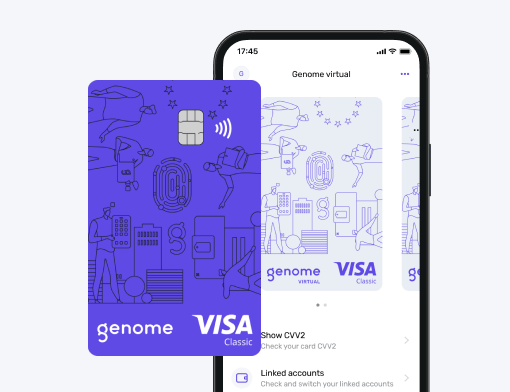
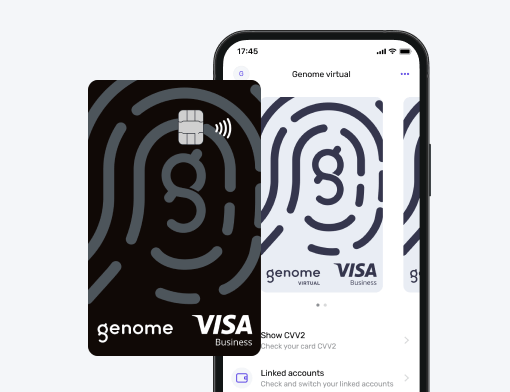
You can hold balances, exchange between them, and send payments via SWIFT transfers in a currency of your choosing. You can also link most of the currency accounts to Genome’s virtual and physical Visa cards.
Our future card payment processing feature will allow you to accept card payments in EUR, USD, and GBP.
Step-by-step: getting your startup merchant-ready
Our merchant services can be accessed through the business wallet. This is not a standalone product. It means your payments and your business finances are connected from the start.
Here’s how it works in practice:
Step 1: Open a Genome business wallet
This is the entry point for everything. The business wallet is where your funds live, where your 12 currencies are managed, and where incoming merchant settlements land. Open the wallet first, and the merchant application comes next.
Step 2: Complete verification (KYC/KYB)
Identity and business verification happen entirely online. You upload your ID and company ownership documents through the platform. The process follows standard Know Your Customer and Know Your Business requirements, but without the in-person appointment some traditional institutions typically demand.
Step 3: Apply for your merchant ID
Once your wallet is verified and active, you apply for a merchant account. Genome’s team reviews your business model, your expected transaction volumes, and any specific processing requirements at this stage. Whether you’re a low-risk merchant account category – SaaS, digital services, online commerce, or you operate in a sector that typically requires high-risk merchant account treatment, you can apply – just ensure that you check the list of permitted countries and prohibited activities first.
Step 4: Complete your integration
Once your merchant account is approved, your account status will change to “Configuring your account”. You can move forward with a technical integration using Genome’s hosted payment page (or host-to-host page, which will be available soon).
Optimizing cash flow with instant settlements
One to three business days. Usually, that’s how long you wait for funds to settle with most legacy payment processors (though some merchants may see longer holds depending on risk rules and payout schedules). For a startup managing payroll, ad spend, and hosting costs on a tight cycle, that waiting period isn’t just annoying, it’s a structural cash flow problem.
The industry has those delays for its own reasons: batch processing, risk buffers, and correspondent banking relationships.
If you go with the euro, instant bank payments inside Genome work differently. Payments settle in seconds. When a customer completes a Pay by Bank transaction using SEPA Instant Transfers, the funds hit your Genome business wallet soon after. No waiting until Friday to see what came in on Monday.
For e-commerce businesses moving money across European markets, this changes the cash flow picture entirely. You’re no longer financing a two-week float for your payment processor. The money you earn today is available today, which means better visibility, more flexibility, and one less thing to stress about at the end of the month.
Open an account
in Genome online
Security and compliance made easy
Customers are trusting you with sensitive financial information every time they check out. That trust needs to be backed by something real – not just a padlock icon on your checkout page.
Genome is a licensed EU Electronic Money Institution, supervised by the Bank of Lithuania.
That regulatory status isn’t cosmetic. It means the Genome is subject to compliance obligations under European financial law. When you build on Genome merchant services, you’re building on infrastructure that has to meet those standards, not just claim to.
The compliance framework covers what matters most for digital businesses operating in Europe today:
PCI DSS – the payment card industry’s baseline standard for handling cardholder data securely.
PSD2 – the EU directive that governs Open Banking for merchants and requires strong customer authentication for online transactions.
DORA – the Digital Operational Resilience Act, setting IT risk management and continuity standards for financial entities.
GDPR – the data protection regulation that governs how customer information is collected, processed, and stored.
For founders building products that touch European consumers’ financial data, this isn’t optional reading. It’s the regulatory environment you operate in. Having a payment infrastructure provider that’s already built to operate in line with PCI DSS and key EU regulatory requirements (PSD2/SCA, GDPR, and DORA obligations where applicable) means you don’t start from zero.
This applies whether you’re operating as a low-risk merchant account – the typical category for SaaS platforms, digital services, and clean-model e-commerce – or whether your business model places you in high-risk merchant account territory due to your industry or geography. The compliance infrastructure is the same either way.
Conclusion: build on infrastructure that keeps up with you
The way startups get paid has changed. The way most merchant account providers think about startups hasn’t yet caught up.
Legacy banks still run underwriting processes designed for businesses with physical premises, predictable local revenue, and three-year financial histories. Most early-stage startups have none of that. The mismatch isn’t going away, and the cost of trying to navigate it, in terms of time and opportunity, is real.
Genome merchant services exist for startups that don’t have time to wait. The multi-currency business wallet, SEPA Instant Transfers, instant settlements with Open Banking for merchants, upcoming card payment processing, and the integrated financial ecosystem all point in the same direction: a platform built around how digital businesses actually work. Just checking our guide on “How to open a merchant account for startups” will help you better understand why partnering with us can be beneficial for your company.