

Have you ever experienced a freeze on your media buying cards? Generally, this is a short answer to the question posed by the article, but it runs deeper. The thing here is scaling – you can normally do a low- or even mid-budget ad campaign. But with big numbers come problems.
Typical case: your bank flagged the transaction. Maybe it’s a fraud alert. Maybe a system error. It doesn’t matter – one blocked ad account can freeze the card attached to every other campaign you’re running.
It is one of the reasons why many marketing agencies have moved to virtual cards, and why you probably should have switched to virtual cards for ad spend already.
The hidden risks of using traditional corporate cards for ads
Your bank didn’t design its fraud system with media buyers in mind. It doesn’t see it as you using a media buying card for advertising, but rather as multiple charges to Meta, Google, TikTok, etc.
Frequent declines and flagged transactions.
If you are planning to scale campaigns quickly or test niche ad platforms, you should make sure your payment setup can handle unusual spend patterns. Otherwise, legitimate ad payments may be declined or flagged, which can lead to paused campaigns, disabled payment methods, billing reviews, or temporary account restrictions.
High-velocity ad spend can sometimes trigger banks’ fraud risk systems. As usual, it’s going to happen at the worst possible moments – peak seasons, live A/B tests, Black Friday, etc.
And once a card gets flagged, getting it unlocked means calls, holds, and explanations. While you wait, your campaigns are paused.
The worst part is the timing. Banks don’t flag transactions when things are slow. Fraud checks are more likely to react when your spending pattern suddenly changes, which often happens exactly when a campaign starts scaling.
The nightmare of shared details
Here’s a marketing scenario that can occur: your business has one card for five media buyers under three client accounts.
Someone has overspent on client A’s campaign, and now client B’s ads have stopped running. Month-end reconciliation becomes a forensic exercise. And security-wise, sharing raw card numbers over Slack just isn’t it.
There’s also the access problem. When a team member leaves, or a freelancer’s contract ends, you can’t easily revoke access to a physical card number that’s already saved across multiple ad platforms. You need to cancel the card – potentially disrupting every campaign attached to it.
Open an account
in Genome online
What are dedicated virtual cards for media buying?
Virtual cards are real card numbers that can usually be used anywhere eligible credit or debit cards are accepted, including major ad platforms such as Meta, Google, and TikTok, depending on the card issuer, country, currency, and platform payment rules. They exist only in software. No plastic. With the right provider, you can create one quickly from your account dashboard.
If regular cards try to be jack-of-all-trades, virtual cards are an isolated payment method, a very specific one.
One campaign – one card. One client – one card. One platform – one card. You control the budget per card, and nothing bleeds over.
Separate Google Ads virtual card, separate Meta card, or even a separate card just to scale Facebook ads.
Think of it like giving each campaign its own wallet. If each virtual card has its own budget or spending limit, that card can only spend within the amount you allow. Once the limit is reached, further payments are declined automatically, helping prevent overspending without manual checks.
4 reasons E-commerce brands and agencies need virtual cards
Isolate risk and prevent Ad account bans
An ad account gets restricted or disabled? The payment method attached to it can become part of the billing or recovery process, too. If that’s your main company card, you’ve just paused every campaign running off it.
It is one of the more painful lessons companies learn the hard way. In some cases, a policy violation or billing issue on one client’s account can trigger a cascade: the card may need to be reviewed, replaced, or removed, and other accounts using it can stop spending.
Virtual cards for ad spend help reduce this risk. If something went wrong, you could disable or replace the affected card without exposing your main company card or disrupting every other campaign tied to the same payment method.
Set custom spending limits
You can sometimes read horror stories on the internet about companies overspending on ads. The answer to the problem? Setting the limits. For example, if your budget is $4,000 this month, set the card limit to $4,000. If your provider supports hard card limits, the card can decline charges above the amount you set. This makes overspending harder, especially when used together with platform-side budgets and regular monitoring.
Managing agency ad spend across multiple clients becomes genuinely good when each client has their own card with a hard cap. You’re not relying on people to check budgets manually or on platform-side spend controls that sometimes miss issues in a timely manner. The limit is enforced at the payment level – adding another layer of control beyond manual checks and platform-side budget settings.
It also helps with forecasting. When every card has a set ceiling, your total committed spend is always visible and accurate.
Instant issuance for seamless scaling
New client onboarding? New platform test? Seasonal campaign kicking off tomorrow? With the right provider, you can generate a new virtual card quickly, without waiting for a physical card to arrive.
For Google Ads virtual card setup or scaling Facebook ads on short notice, this is the difference between launching on time and missing the window. E-commerce advertising spend is heavily seasonal – Black Friday, back-to-school, summer sales – and the ability to stand up new payment infrastructure quickly, rather than waiting for a physical card, is a real operational edge.
Agencies pitching new clients can also move faster. There’s no “waiting for the card” stage between signing the contract and the campaigns going live.
Effortless expense reconciliation
If every card is labeled by client, platform, or campaign, every charge is easier to track. Finance doesn’t have to play detective at the end of the month.
Reporting for ad campaigns would be straightforward. Each card maps directly to a client, a platform, a campaign, or any specific spending.
For larger agencies or companies with huge e-commerce advertising spending, billing on performance or running cost-plus models, this level of transparency also builds trust. You’re not sending a spreadsheet you manually assembled. You’re pulling clean data that was structured from the start.
Streamline your ad spend with Genome
Genome is a Lithuania-based European EMI designed for businesses that move fast and need their payment infrastructure to keep up.
What you get with our virtual cards for media buying:
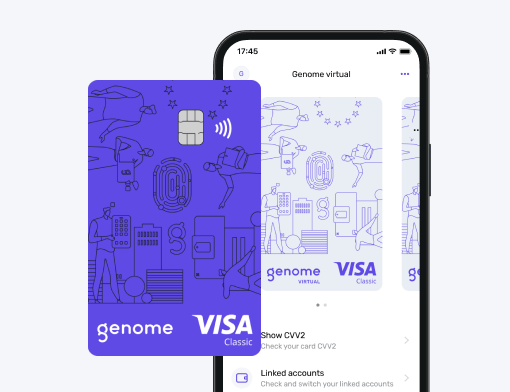
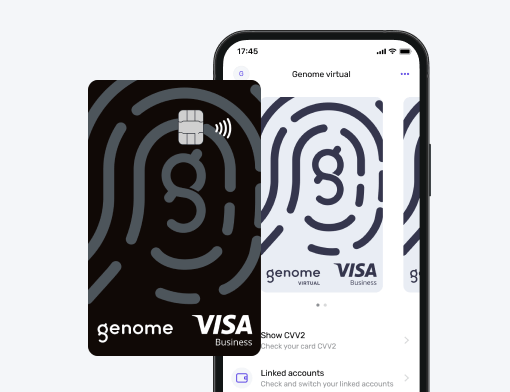
Hundreds of virtual cards generated from one wallet for your business needs, including ad spending and media buying.
Per-card spending limits you set and control.
Multi-currency support: Genome cards can be linked to accounts in EUR, USD, GBP, PLN, CHF, CZK, HUF, SEK, and DKK.
Flexible card limits suited to serious e-commerce advertising spend, all managed under a single dashboard.
A virtual PIN feature for Genome virtual cards. Add your virtual card to Apple Pay, Google Pay, or Garmin Pay, set a PIN, and withdraw cash at supported contactless ATMs when needed.
Additionally, we offer a variety of other features for your business needs.
With Genome, you can open up to 5 accounts in each supported currency, making it easier to separate funds by market, client, campaign, or operational need. Currencies available: EUR, USD, GBP, PLN, CHF, JPY, CAD, CZK, HUF, SEK, AUD, and DKK.
For transfers, Genome supports SEPA and SEPA Instant payments for fast euro transactions across Europe. Businesses can also receive and send international transfers via SWIFT to and from 161 countries and territories. They can use other available payment rails, depending on the destination, currency, and payment corridor.
Genome also supports businesses that want to accept payments. Merchant services include Open Banking-powered instant bank payments and hosted payment pages, giving companies more ways to collect funds from customers and manage revenue within the same financial ecosystem. Card payment processing is coming soon as well.
We are a regulated European financial platform supervised by the Bank of Lithuania, built for companies that need secure, digital-first business finance services.
For media buyers, e-commerce brands, and agencies, this means fewer manual workarounds, cleaner budget control, easier reconciliation, and a payment setup that can scale together with your campaigns.
Open an account
in Genome online
Conclusion
Maybe years ago, one corporate card was enough to manage ads. But now, with so many social media websites and influencers in the marketing culture, it is not. The tools running your campaigns have evolved. The card funding them probably hasn’t.
For any agency managing multiple clients or any e-commerce brand scaling across platforms, virtual cards for media buying are the baseline. With dedicated virtual cards, it becomes easier to manage agency ad spend across multiple clients, platforms, and campaigns without relying on one shared payment method.
Unlock hundreds of virtual cards for ad spend with Genome’s business wallet and simplify your media buying efforts!