

Why is this question pretty constant among clients? The truth is, it is usually caused by different issues people face when making transfers: overpaid fees out of nowhere, a payment that got lost and was found a week later, an intermediate cut in a transaction from a bank you never heard of, or an instant transfer that was not as instant as advertised.
These are real-life stories, and understanding SWIFT vs. SEPA Instant for business transfers means understanding where those problems appear and why they can be slightly confusing.
Our team wants to give you a closer look at how the two systems actually work in practice from the perspective of a payment provider that operates in Europe.
Decoding European and global payment rails
Before comparing SWIFT vs. SEPA Instant for business transfers directly, it will be helpful to know what each network does – and why people are still confused about them.
What are SEPA Instant Transfers for business?
SEPA Instant Transfers, which are processed through the SEPA Instant Credit Transfer (SCT Inst) scheme, allow people and companies to send and receive euro-denominated funds in real time, landing in the recipient’s account within 10 seconds, 24/7/365.
Since October 2025, EU regulation has required payment service providers in the euro area to offer payee-name verification before a standard or instant euro transfer is authorized. It can warn you if the recipient’s name does not match the IBAN, helping you detect mistakes before sending the money. However, depending on the result, you may still be able to proceed with the transfer. This matters because instant payments are generally difficult to reverse once completed.
But “instant” doesn’t mean “unlimited.” The old €100,000 scheme-level maximum per SEPA Instant transfer was removed in 2025, but payment providers and businesses may still apply account, channel, or user-defined transfer limits.
A SEPA Instant business transfer can be domestic or cross-border, provided both the sender’s and recipient’s payment providers are reachable through the scheme. Availability may vary in SEPA countries outside the EU, where the EU Instant Payments Regulation and its implementation deadlines do not necessarily apply in the same way.
Open an account
in Genome online
What is a SWIFT international money transfer?
SWIFT (Society for Worldwide Interbank Financial Telecommunication) is the messaging network underpinning most global cross-border banking – it lets more than 11,500 financial institutions and corporations exchange standardized payment instructions, while the actual movement of funds is handled by the participating banks, often through correspondent banking relationships.
A SWIFT international money transfer can move virtually any major currency to more than 200 countries and territories, which is exactly why it remains a common option when a payment needs to be sent outside the SEPA area or in a currency other than EUR.
SWIFT is one of the oldest systems, having been founded in 1973, well before the public internet.
One of the most common problems is that the amount that lands into one’s account can be smaller than the amount sent, because a correspondent bank along the route may deduct a handling fee. The final amount depends on the payment route and the selected fee arrangement, such as OUR, SHA, or BEN.
It is a common friction point with some SWIFT international money transfers. Fees may not always be clear to the sender or recipient before the payment is completed.
Why does it work like this? Because it is not a payment system in the modern sense: it doesn’t hold or transfer the funds itself. Instead, it securely exchanges payment instructions between financial institutions, while the banks involved execute and settle the transfer. When correspondent banks are involved, each institution may add processing time or fees.
SWIFT vs. SEPA Instant for business transfers: feature comparison
To better understand the SEPA Instant settlement speed and how it compares to SWIFT, we’ve prepared a table to compare the two systems. SEPA Instant settlement speed and SWIFT global reach are each system’s main advantages.
Operational dimension | SEPA Instant Transfers for business | SWIFT international money transfers |
Primary region | 41 SEPA member countries (Eurozone focused) | Global (200+ countries and territories) |
Supported currencies | Strictly EUR | Multi-currency (USD, GBP, EUR, JPY, CAD, etc.) |
Execution speed | Real-time (under 10 seconds, 24/7/365) | 1 to 3 business days (subject to cutoff times and correspondent banks) |
Cost structure | Low, predictable flat fees per transfer | Higher variable costs (SWIFT fees, correspondent bank charges, FX margins) |
Transaction limits | No EU-wide cap since October 2025, but individual bank and per-destination limits still apply and vary widely | Typically unlimited (subject to individual bank limits and compliance checks) |
Settlement speed: real-time execution vs. banking cutoff windows
The SEPA Instant Transfer settlement speed is measured in seconds, at any hour, on any day of the year. But instant transfers aren’t immune to outages: if the recipient’s payment provider is not reachable through SCT Inst or the service is unavailable, the payment may be rejected. It will only be sent as a regular SEPA Credit Transfer if the provider offers that fallback and the sender agrees to it.
Roughly speaking, the recipient’s payment provider must generally make the funds available within 10 seconds. If the sending provider does not receive confirmation within that period, it must immediately restore the sender’s account to the position it would have been in without the transfer.
By the way, that’s an underrated advantage of SEPA Instant settlement speed as a design: failure is fast and visible, instead of a wire potentially requiring an investigation when it is delayed or held by one of the banks involved.
SWIFT payments run on a fundamentally different clock. A transfer may pass directly between two institutions or through one or more intermediaries, while its end-to-end completion time can depend on cutoff times, local business hours, compliance checks, time zones, and the receiving bank’s processes.
Simply speaking, SWIFT transfer times can vary depending on the payment route and the banks involved. It is also why cross-border payment costs can sometimes be difficult to predict.
Cost breakdowns: transfer fees vs. correspondent markups
So, how much does a cross-border payment cost with SWIFT?
Imagine a business sends an international payment, with neither the sending nor receiving bank showing a fee. However, the recipient receives less than expected because an intermediary bank deducts its own handling fee while processing the transfer. This is why the final cost of a SWIFT payment may not always be clear in advance.
When it comes to cross-border payment costs, European experience with SEPA is more favorable. In some cases, converting funds into EUR and sending a SEPA Instant Transfer may cost less than using SWIFT, but the total cost depends on the exchange rate, FX fees, and transfer charges.
That does not mean every SWIFT transfer is expensive. Some banks offer low or even zero visible sending fees for certain international transfers. The issue is predictability.
Geographic coverage and currency flexibility
SEPA Instant’s reach is intentionally narrow: the wider SEPA geographical area covers 41 countries and supports EUR payments only. However, actual SCT Inst availability depends on whether the payment providers involved support the scheme.
Usually, SEPA is suitable for EUR transfers within its geographical area, while SWIFT is commonly used for USD and other currencies or destinations outside SEPA.
There is an important nuance here. A country being part of the SEPA geographical area does not automatically mean that every payment to it is a SEPA payment. Currency matters.
Using IBANs does not automatically mean that transactions would be carried out using SEPA.
For example, if you make a payment in USD to an account identified by a euro-area IBAN, it cannot be processed as a SEPA transfer. Depending on the recipient bank and account capabilities, the payment may be accepted through SWIFT or another supported route and converted, held in USD, or rejected.
It means SEPA geography should never be treated as a substitute for checking the currency and receiving-bank capabilities.
Choosing the right payment rail for your operational workflows
European supplier payouts and payroll automation
At this point, SEPA Instant Transfers are well suited to many EUR-denominated vendor invoices, contractor payments, and payroll runs within the SEPA area, provided the recipient’s payment provider supports SCT Inst – funds confirm in seconds, or failed transfers are normally reported quickly rather than remaining unresolved within a correspondent banking chain. The reconciliation stays clean.
Routing recurring domestic payouts through the SEPA Instant Transfer for business accounts also removes the dependence on standard SEPA processing cycles and banking cutoffs. However, both standard and instant SEPA payouts can be automated or submitted in batches, depending on the provider.
Global supply chain and multi-currency treasury management
For a global business: instead of treating SWIFT vs. SEPA Instant for business transfers as an either-or choice, consider using a multi-currency account that supports both options.
That can help keep supply chains funded on schedule and avoid repeated currency conversions when funds are received and paid in the same currency.
There is no single route that works best for every payment: you may use SWIFT for one transfer, convert USD to EUR and use SEPA for another, or send GBP through Faster Payments when both accounts are eligible.
Multi-currency business accounts are therefore a practical option if you regularly receive, hold, and send several currencies.
Managing specialized industry payout requirements
Some business models need both transfer options running in parallel. For example, businesses serving multiple markets may use SEPA Instant for eligible EUR payouts and SWIFT for payments in other currencies or to destinations outside the SEPA area. SWIFT offers broader currency coverage, but it does not guarantee instant settlement.
But even where instant rails exist, not every payout lands within seconds – a transaction may require sanctions, fraud, or AML screening before it is released, depending on its risk profile and the provider’s compliance controls. Cross-border payments may also carry transfer, intermediary, or currency-conversion fees.
A company operating under a travel agency merchant account faces a similar struggle: the same platform may collect payments from customers in Germany while paying a hotel chain in Southeast Asia through SWIFT. Relying on one rail may not be practical in this situation.
The combination of both services is what Genome offers.
Optimize your global business transfers with Genome
Choosing between SWIFT vs. SEPA Instant for business transfers isn’t really either/or. It’s all about matching the right transfer method to each payment.
At Genome, an EU-licensed Electronic Money Institution supervised by the Bank of Lithuania, we prefer to be prepared for any scenario.
Our business account comes with a dedicated business IBAN in euros and built-in SEPA Instant Transfers that arrive in seconds and work 24/7/365, provided the recipient’s payment provider supports SCT Inst. Transfers are also backed by Verification of Payee (VoP), which checks whether the beneficiary’s name matches the IBAN and warns you about a mismatch before the money moves.
For eligible international B2B payments, businesses can send and receive international money transfers to and from 161 countries and territories across 12 major currencies, including EUR, USD, GBP, PLN, CHF, JPY, CAD, CZK, HUF, SEK, AUD, and DKK. Depending on the destination and currency, payments may be routed through SWIFT or supported local payment systems.
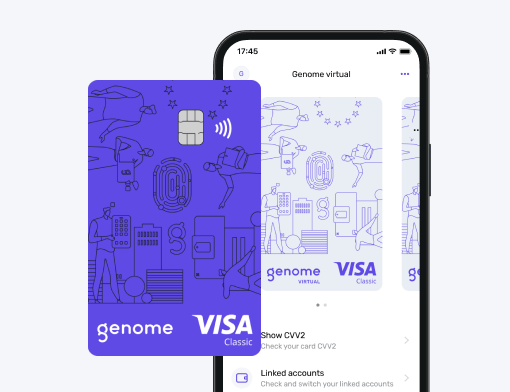
With a multi-currency business account, you have 12 major currencies available for international business transfers and can link your Genome-issued virtual and physical Visa cards to accounts in EUR, USD, GBP, PLN, CHF, CZK, HUF, SEK, and DKK.
When it comes to discussing SWIFT vs. SEPA Instant for business transfers, it is not a competition. Many international businesses benefit from access to both, and we are happy to provide these services.
Open an account
in Genome online