


international money transfers
Business services
SWIFT vs. SEPA Instant for business transfers: costs, speed, coverage
Why is this question pretty constant among clients? The truth is, it is usually caused by different issues people face when making transfers: overpaid fees out of nowhere, a payment that got lost and was found a week later, an intermediate cut in a transaction from a bank you never heard of, or an instant transfer that was not as instant as advertised. These are real-life stories, and understanding SWIFT vs. SEPA Instant for business transfers means understanding where those problems appear and why they can be slightly confusing. Our team wants to give you a closer look at how
Business services
Cross-border B2B transactions: how to scale international supplier payments safely
“Why did my supplier receive less than I sent?” is quite a common question you may find on the entrepreneur forums. Finding the right supplier abroad can already be tough, and you really don’t want any more problems associated with the process. Very common setup: a semiconductor manufacturer in Taiwan, a component maker in the USA, and your factory in the EU. Asia-America-Europe, multiple currencies, and regular shipments literally around the world. You will be paying them invoice after invoice – supply, shipment, currency conversion – and it’s your responsibility to pay on time, in full. Cross-border B2B transactions are

Business services
Business account in Europe: how to choose the right corporate account for international transfers
Decades ago, international payments were primarily a concern for large enterprises. In some sense, you could say they were truly international. Today, even a smaller company can have offices in 20 countries, dozens more warehouses, and manufacturing facilities around the world. All of that is an administrative burden, multiple taxes, and far more complexity than there should be. Nowadays, small and mid-sized businesses routinely operate across borders. FXC Intelligence projects SMB cross-border payment volumes will jump 54%, from $13,8 trillion in 2024 to $21,2 trillion in 2032. Yet payment infrastructure doesn’t always keep up with demand. Payment delays, transaction declines,

Business services
How to manage currency conversion fees and FX risk in global e-commerce
There is a saying that currency conversion fees quietly eat into your margin. We are about to disagree: not quietly anymore. FX risk in e-commerce is not a minor inconvenience. Recent currency volatility has already had a measurable impact on businesses. For example, 48% of UK corporates surveyed said they had lost money in 2025 because of large swings in sterling’s value. Another example comes from a personal finance platform. Despite reporting a 15% year-over-year increase in revenue in Q1 2026, the company posted a net loss of $6.7 million. It was primarily driven by non-cash and currency-related adjustments, including
Product news
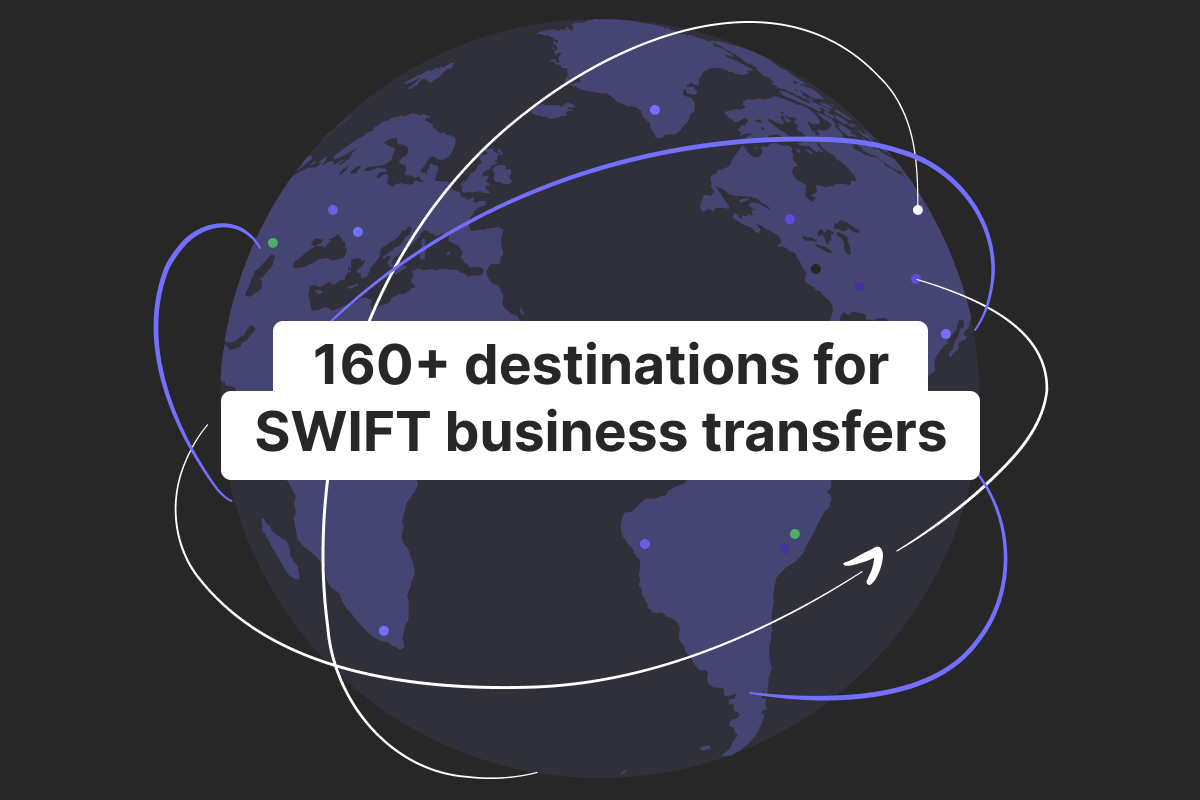
Genome expands SWIFT business transfers to 161 countries and territories!
At Genome, we are constantly working to break down financial borders for your business. We understand that to scale successfully in today’s economy, you need a financial partner that can keep up with your global ambitions. That is why we are thrilled to announce a massive expansion of our international transfer capabilities! Genome business clients can now send and receive high-value SWIFT payments across 161 countries and territories! Our SWIFT transfers for business are available in 12 currencies: EUR, USD, GBP, PLN, CHF, JPY, CAD, CZK, HUF, SEK, AUD, and DKK. This update significantly broadens your company’s reach, allowing you

Product news
Welcome, UAE! Genome expands business onboarding of United Arab Emirates companies
Our team continues to expand Genome’s services for companies operating internationally. Today, we are happy to share an important update: the United Arab Emirates is now approved for onboarding business clients under a high-risk classification and pricing model. Eligible UAE-registered companies can now apply for a Genome business account and use a wide range of our financial services, including international SWIFT transfers! What this update means for UAE businesses With this update, UAE business clients can be reviewed and onboarded under Genome’s high-risk business account pricing. This is especially useful for companies that operate across borders, work with international partners,
Business services
Mastering B2B cross-border payments: optimizing SWIFT transfers
Update: Genome has expanded its network! You can now execute SWIFT transfers for business to and from 161 countries and territories. B2B international payments are becoming harder to manage as global trade, supplier relationships, and currency markets keep changing. Tariffs, new regulations, regional payment rules, FX volatility, and shifting supply chains can all affect how quickly and cost-effectively businesses move money internationally. For companies managing international supplier payments, intercompany transfers, and contractor settlements, even small delays or unexpected fees can create operational pressure. It is especially true for high-value cross-border payments using SWIFT transfers, where routing, intermediary banks, and compliance
Money and you
Money transfers in Europe: which option is better?
Imagine a scenario: you’re trying to pay your rent in Berlin or send money to Europe for a birthday gift. While doing it, you see a screen asking if you want to use the “SWIFT” or “SEPA” option. This is where knowing the difference matters, especially if you want to avoid unnecessary fees. Money transfers in Europe can be a complicated subject. Because, despite the EU’s best efforts, the continent is still a patchwork of different “rails.” The Eurozone uses SEPA, the UK relies on its own Faster Payments system, and everything else is often routed through the global SWIFT
Money and you
SEPA vs. SWIFT transfers: key differences explained
SEPA (Single Euro Payments Area) is a European payment scheme that enables euro transactions across participating countries, making domestic-style transfers possible across borders. It’s designed for payments in EUR between bank accounts held at a bank in the SEPA zone. It has rules around formats, timelines, and fees, especially for SEPA payments. SWIFT (Society for Worldwide Interbank Financial Telecommunications), by contrast, is a global messaging network used by financial institutions to route payment instructions worldwide. It’s often associated with cross-border wires and correspondent chains, which is why swift payments can involve more intermediaries, variable fees, and less predictable settlement speed.