

Decades ago, international payments were primarily a concern for large enterprises. In some sense, you could say they were truly international.
Today, even a smaller company can have offices in 20 countries, dozens more warehouses, and manufacturing facilities around the world. All of that is an administrative burden, multiple taxes, and far more complexity than there should be.
Nowadays, small and mid-sized businesses routinely operate across borders. FXC Intelligence projects SMB cross-border payment volumes will jump 54%, from $13,8 trillion in 2024 to $21,2 trillion in 2032.
Yet payment infrastructure doesn’t always keep up with demand. Payment delays, transaction declines, and lack of payment options are part of a bigger problem – banking infrastructure is old and expensive, and the bigger your company is, the more money and time you will need for an upgrade. Learn how to manage cross-border business payments with the right international business account in our article!
What to look for in a corporate account for international transfers
To be clear, most banks or payment providers can process different types of payments and transfers. The questions you might have for cross-border business payments are how many you can send, how fast they will settle, and at what cost.
The differences between payment providers only show up once your money actually has to cross the border. If you are setting up a business account in Europe, we can highlight three things to look for.
Broad multi-currency infrastructure
It is certainly a must-have for any business that works internationally. To make sure you’re ready for most scenarios of using different currencies for transfers, it is better to hold all popular currencies like EUR, USD, GBP, etc., instead of converting everything on the spot.
The difference could be substantial because currency volatility is real, and companies lose millions of dollars to it.
For example, a good multi-currency business account lets you receive euro payments, hold them in euro, and pay a euro supplier without two pointless conversions. Or you can receive money in USD and just hold it for better days, when the currency rate is more favorable.
Open an account
in Genome online
Transparent pricing and exchange rates
Unlike Genome, which displays its pricing in full, not all payment service providers display the complete pricing for their services, and companies can face hidden fees. These can show up in the exchange rate spread, in an intermediary bank fee, or in a tiered pricing structure.
Look not only at low-risk business account pricing, but generally, flat, fully disclosed fees and a clear markup over the interbank rate.
If a provider can’t tell you exactly what a transfer will cost before you send it, you are more likely to encounter hidden fees.
Processing speed and reliability
The European Commission’s 2025 Payment Observatory Analysis found that more than half of EU businesses had trouble with late payments, with average B2B payment periods stretching past 60 days.
And if we are talking about exports, delays in cross-border business payments, different banking cut-off times, currency conversion, and correspondent banking chains can add even more complexity than in purely domestic payments.
To quote the report:
“Amid economic uncertainty and a slowdown, companies are increasingly concerned about late payment practices. The consequences of a poor payment culture are diverse, with impacts on investment and growth most frequently cited. In addition, pursuing late payments represents a significant administrative burden for companies.”
And so, international business accounts that handle a high volume of transactions, at least in a reasonable timeframe, require software and hardware.
For instance, high-risk businesses have enormous payment volume, and not all regular payment providers can handle it, despite its profitability. If you handle high volumes of transfers, you might require a specialized payment provider that works with high-risk businesses.
Traditional European banks vs. digital financial platforms
Decades of institutional trust, a huge financial product portfolio, reputation, regulatory ties built over generations, and, more commonly, physical branches where you can ask questions face-to-face. This is enough for many clients to have traditional banks as a default choice for payment service provision.
But for most growing businesses, new companies where pricing and speed are important, a traditional bank just doesn’t do it.
Opening a corporate account for international transfers may involve weeks of paperwork and additional verification checks. Plus, SWIFT transfers for business are often one of the core options traditional banks provide, while more flexible digital payment tools, API-based services, or Open Banking-powered checkout solutions may not always be part of the standard business account package.
Online payment providers and neobanks are mostly fully digital. It means that, like in the case with Genome, the onboarding is done entirely online, and mobile apps are a core feature, not secondary.
They can also operate faster and offer more competitive pricing because they do not rely on the same branch-based service model, although actual fees, FX rates, and transfer speed still depend on the provider, currency, payment rail, destination, and compliance checks.
Navigating international networks: SEPA vs. SWIFT
For bank-to-bank business transfers in Europe, SEPA and SWIFT payments are two of the main networks to understand. Business accounts in Europe should, by default, use SEPA for euro transfers within the SEPA area and SWIFT for dollars and other widely used currencies when local payment rails are not available.
SEPA for smooth European transfers
The Single Euro Payments Area (SEPA) covers euro transfers across more than 30 European countries, and SEPA Instant Transfers settle funds in seconds rather than days.
This is your bread and butter for everyday business activities within the EU. Even if you are not in Europe but want to work in this market, an international business account should have SEPA support, because it is the cheapest and fastest option out there, and there’s rarely a reason to route that kind of payment through anything heavier.
Genome supports both SEPA Credit and Instant Transfers for international transfers. Additionally, we allow merchants to use SEPA to accept account-to-account payments from customers via Pay by Bank.
SWIFT for global coverage
SEPA’s reach stops at the euro and at Europe’s borders. The moment you need to pay a supplier in the USA or Asia, or, on the contrary, receive money from them, SWIFT transfers for business become your only real option.
Yes, it’s slower and pricier than SEPA, but that’s the trade-off for global reach instead of speed. Which is exactly why the strength of a provider’s SWIFT network, not its SEPA setup, ends up deciding how useful a business account in Europe actually is once you’ve got ambitions outside the continent.
Inside Genome, eligible businesses have access to SWIFT international transfers that cover over 160 destinations.
Scaling globally with Genome: the smart business choice
Genome was built in a European financial hub, and we have the infrastructure to handle currencies, countries, and different transfer methods all at once.
A complete multi-currency ecosystem
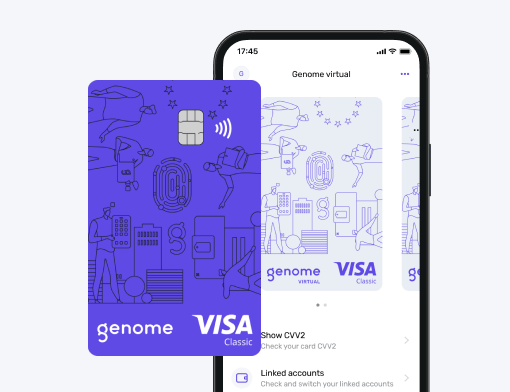
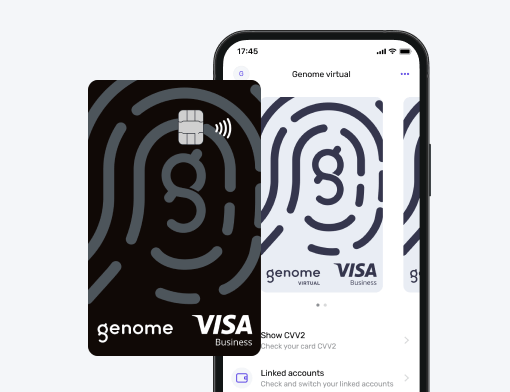
A Genome business wallet gives you a dedicated multi-currency business account, virtual and physical corporate Visa cards, and merchant account tools for taking customer payments, all in one dashboard instead of three different logins. Accounts are available in 12 currencies (EUR, USD, GBP, PLN, CHF, JPY, CAD, CZK, HUF, SEK, AUD, and DKK), and you can open up to 5 accounts per currency to keep budgets, departments, or client funds separate.
We are a licensed Electronic Money Institution regulated by the Bank of Lithuania, hold ISO 27001 and ISO 27701 certifications, and are GDPR, PCI DSS, and PSD2-compliant.
Open an account
in Genome online
Breaking borders: SWIFT transfers to 161 destinations
We just rolled out a major expansion of our international transfer setup: business clients can now send and receive high-value SWIFT payments across 161 countries and territories, in the same 12 currencies we mentioned for multi-currency accounts.
The Intelligent Routing System automatically picks the most efficient path for each transfer, optimizing for cost and speed instead of just defaulting to whatever route is slowest.
In practice, that expansion solves three specific problems:
1. Paying a tech vendor in the US and a manufacturer in South Korea? You no longer need a separate banking relationship for each one. One SWIFT transfer for business connection covers both.
2. Funding a new branch or subsidiary in the UAE or Australia? Move the capital through the same dashboard you already use for everyday EUR payments.
3. Collecting contract payments from clients in Japan or Canada? They don’t have to figure out some unfamiliar local banking system just to pay you.
That’s what a corporate account for international transfers is actually for: closing the gap between where your business operates and where your money needs to go.
Elevate your international transfer strategy today
The account you use to move money internationally isn’t some back-office detail. A well-chosen international business account will let you focus on the suppliers, subsidiaries, and clients that matter instead of managing your corporate accounts.
If your current setup still means waiting days for a transfer to clear, or guessing what a wire will cost before it lands, it’s worth checking your eligibility for something built for how international business actually works today.
With Genome, you get a multi-currency infrastructure, transparent pricing, and now – SWIFT transfers for businesses that cover 161 countries and territories, all in one platform.
Leave the legacy constraints behind: check if you’re eligible for SWIFT transfers, open a Genome business account, and put a business account in Europe to work for you!