

Paying online is not just entering a credit or debit card number at checkout. Traditional card processing still dominates non-cash payments in Europe, powering billions of transactions through card networks and merchant accounts.
Numbers will speak better than any words – just look at the latest official statistics from the European Central Bank.
The total number of non-cash payments in the euro area in the first half of 2025 was 77.7 billion transactions. Card payments accounted for 57% of non-cash payments, totaling 44 billion, with a value of 1.7 trillion euros.
While this model still works well, Open Banking is quietly gaining market share. Instead of relying on card networks, Open Banking can enable direct bank-to-bank payments from a customer’s bank account – often faster and, in many cases, cheaper.
If we go back to European statistics, we can see that the number of credit transfers within the euro area was 16.8 billion, but the total value was €107.3 trillion.
In other words, card processing is dominant, but credit transfers accounted for 92% of the total value of non-cash payments.
Of course, it does not mean Open Banking checkout payments are already close to cards in retail usage, because ECB credit transfer totals also include many high-value ordinary bank transfers. However, the importance of bank-to-bank payments is clear. After we explain how Open Banking transfers work, you will understand why.
Understanding the contenders
Before comparing card processing and Open Banking, it’s helpful to understand how each works.
How traditional card processing works
Card payments rely on a multi-party ecosystem that processes transactions between the customer and the merchant.
A typical card transaction involves four participants:
The customer (cardholder)
The merchant
The acquiring bank (via the merchant account)
The card network and issuing bank
When a customer pays with a card, the merchant’s merchant account sends a request to the issuing bank via the card network. If the bank approves the transaction, the payment is authorized. However, the actual transfer of funds happens later during settlement.
This model effectively authorizes payment against the customer’s available bank balance or credit limit. While convenient, it introduces multiple intermediaries – with total merchant costs typically including interchange, scheme fees, and processing costs.
As a result, merchants pay card processing fees that vary depending on the card type, geography, pricing model, and risk profile.
Open an account
in Genome online
How Open Banking (instant bank payments) works
Open Banking takes a completely different approach.
Instead of using card networks, Open Banking payments enable customers to transfer money directly from their bank account to the merchant’s account. This is commonly called A2A (Account to Account) payments.
Paying by banking app using biometrics is the most common example you probably already know.
Here’s what technically happens in a typical instant payments flow:
The customer selects “Pay by Bank” at checkout.
They are redirected to their banking app or online banking interface.
They authorize the payment using SCA (Strong Customer Authentication), such as Face ID, fingerprint, or bank credentials.
The bank initiates a bank-to-bank transfer to the merchant’s account. If the payment uses an instant payment rail, the funds are typically received in real time or near real time.
This push-payment model eliminates intermediaries such as card networks and simplifies the payment chain.
In Europe, these transactions are often processed through SEPA Instant if you are using the euro, and Faster Payment works the same way in Great Britain.
The core differences: speed, cost, and risk
Transaction fees
Traditional card payments come with layered costs. Every card transaction includes:
Interchange fees paid to the issuing bank
Scheme fees charged by card networks
Acquirer markups from the payment processor
This pricing structure can be called Interchange++ when these costs are passed through separately. In practice, total card processing fees / interchange fees vary depending on the card type, geography, pricing model, and risk profile.
Note that a high-risk profile for your business usually means higher payment processing fees or being entirely denied opening a merchant account.
By contrast, Open Banking payments bypass card networks entirely. Because payments are made by direct bank transfer, providers often charge lower flat fees or capped percentages.
Payment processing fees for such transfers vary by provider, country, payment rail, and merchant volume. For merchants processing large orders, instant bank payments can dramatically reduce transaction costs.
Settlement speed
Another key difference between card processing vs. Open Banking is settlement speed.
With traditional card processing, funds often settle within 1-3 business days, depending on the provider and setup. This means merchants receive their money after the transaction rather than immediately.
While customers usually are not sensitive to this, businesses don’t like it – especially when inventory, marketing, and operations require immediate capital.
Open Banking payments, however, can support real-time or near-real-time settlement when instant payment rails are used.
Using systems like SEPA Instant, funds can reach the merchant within seconds. This makes instant bank payments particularly attractive for businesses.
Security and chargebacks
Fraud and chargebacks are another major factor here. Card payments are vulnerable to friendly fraud, where customers dispute legitimate purchases to reclaim funds. Even when merchants follow security protocols and have chargeback protection tools, disputes can result in lost revenue and penalty fees.
And the higher the chargeback rate, the worse the condition of a merchant account you can get at a payment provider.
Because of this risk, businesses often invest heavily in chargeback protection tools and fraud monitoring systems.
Open Banking payments change the dynamic. Since pay by bank requires the customer to authenticate the transaction directly in their banking app using SCA (Strong Customer Authentication), the payment is fully authorized by the account holder.
Once completed, A2A (Account to Account) payments usually do not involve card-scheme chargebacks in the same way as card payments, although refunds, recalls, or unauthorized-payment protections may still apply in some cases.
The catch here is implementing the regulatory requirement, but since it is required by law (PSD2 in Europe) and is already a standard part of the payment flow supported by European payment providers and banks, it’s completely fine.
Open an account
in Genome online
User experience: typing numbers vs. FaceID
Beyond cost and security, the checkout experience also plays a critical role in conversion rates.
The “card friction”
Card payments introduce several friction points.
Customers may need to manually enter:
Card number
Expiry date
CVV code
Billing address
In the best case, customers save these in the browser or in online shopping apps, and they are entered automatically. In that case, the checkout experience becomes much smoother.
In other cases, there can be mistyped numbers, expired cards, failed authentication, or other input errors.
The “Pay by Bank” flow
The Pay by Bank experience simplifies checkout dramatically.
With Open Banking payments, the user simply:
Selects Pay by Bank
Chooses their bank
Confirms the payment in their banking app
Authorization occurs via SCA, often using biometrics such as Face ID or fingerprint authentication.
There’s no need to enter card details, remember numbers, or deal with expired cards.
This streamlined experience, in addition to lower payment processing fees, is one reason instant bank payments are gaining popularity in markets such as Europe and the UK.
How Genome unifies both worlds
While the debate around card processing vs. Open Banking often frames them as competing technologies, the reality is more nuanced.
Most merchants need both. The reality is that, statistically, cards are the most frequently used method for online payments, accounting for 48% of transactions. The share of e-payment solutions, i.e., payment wallets and mobile apps, is slowly rising and is now 29%.
Different customers prefer different payment methods, and limiting options can hurt conversions. It is where our hybrid infrastructure becomes valuable. Choose a Genome merchant account to have both options available!
Why merchants still need card processing
Despite the growth of Open Banking payments, card payments remain essential for global commerce. Customers value cards because they offer:
Rewards and cashback programs
Credit options and installment payments
Familiar checkout flows
Genome is soon to unveil card payment processing for our merchants, allowing them to accept payments from customers around the world. Using it, businesses can accept Visa and Mastercard cards while maintaining transparent reporting and simplified reconciliation.
For international e-commerce, card acceptance remains a critical part of the checkout mix.
Why merchants should add instant bank payments (Open Banking)
At the same time, instant bank payments offer advantages that cards simply cannot match. Genome’s Open Banking-powered instant bank payments are really good for:
European customers who prefer direct bank transfers
Businesses that need immediate settlement
High-value purchases where card fees are expensive
Genome’s Pay by Bank infrastructure enables merchants to accept Open Banking payments across the EU. Using it, customers can pay via SEPA Instant and Credit Transfers.
One dashboard for everything
Managing everything from a single dashboard adds another layer of convenience to running your business.
Using Genome’s business wallet, companies can start Genome merchant accounts to:
Accept card payments (coming soon)
Enable Pay by Bank (instant bank payments).
Manage payouts from one dashboard.
Integrate hosted payment pages.
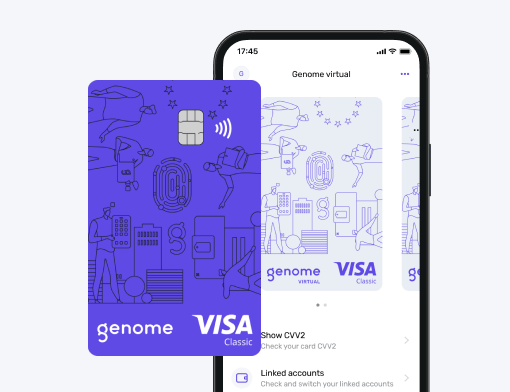
Additionally, we offer businesses dedicated IBANs, multi-currency accounts (EUR, USD, GBP, PLN, CHF, JPY, CAD, CZK, HUF, SEK, AUD, and DKK), international transfers, virtual and physical Visa cards, and more! All our services are available online.
Conclusion
The debate around card processing vs. Open Banking isn’t about replacing one payment method with another, at least for now.
Cards remain essential for global commerce, while Open Banking payments deliver faster settlement, lower fees, and stronger authentication. Still, cards remain more popular to date.
The smartest strategy for modern merchants is to combine both.
Just choose a merchant account that provides card payments alongside instant bank payments.
With us, companies can enable both card processing and Pay by Bank functionality within a single integration – while managing funds through a multi-currency wallet.