

There are many options when it comes to card acquirers if you’re running an e-commerce business or just scaling your business across Europe. Usually, the card acquirer is evaluated based on three things: how much you keep after every transaction, how fast that money hits your account, and how many customers actually complete the checkout.
Yet many businesses care only about headline processing rates. The common story for them is to sign a multi-year contract, and only discover the real costs are hidden in reserve holdbacks, FX markups, or that a provider doesn’t offer a compatible settlement speed for merchants.
Choosing a merchant acquirer means asking the right questions before you sign a contract, not just choosing the lowest advertised processing rate and good pricing. What are the effective fees, not the advertised rate? Why are reserves potentially much more damaging than a slightly higher processing fee? Authorization fees, batch fees, statement fees, PCI DSS fees, cross-border processing fees, and many more that are not advertised upfront.
The choice of a card acquirer in the EEA (European Economic Area) for performing transactions is an important factor, and it can influence the EEA payment processing fees for your business.
Understanding the EEA acquiring landscape
The European Economic Area runs on a largely harmonized regulatory framework – the Interchange Fee Regulation (IFR) caps interchange fees for most consumer debit and credit card transactions at 0.2% and 0.3%, respectively. Commercial cards and certain other transactions are outside these caps. At the same time, PSD2 sets requirements for Strong Customer Authentication (SCA), including for many electronic card transactions, subject to exemptions.
In theory, that framework should make choosing a merchant acquirer a straightforward process. However, in practice it isn’t, because acquirers can structure their pricing differently, with costs spread across different EEA payment processing fees.
Open an account
in Genome online
Why generic acquiring contracts cost merchants more
Generic “one rate for everything” contracts can make it harder to see the gap between the underlying card-processing costs and what the acquirer charges you. Since the interchange caps do not apply to every transaction, commercial cards and some other transactions can have different interchange rates.
That is why your effective pricing rate can be higher than the headline rate (depending on each provider).
There is something you can do here: seek a provider with transparent actual prices and calculate the effective rate by yourself.
If a payment provider does not share prices publicly, you should probably seek another one.
For example, take a look at our business account pricing and merchant account pricing – there are fees for each type of transaction and activity currently listed for Genome’s available merchant services.
Regulatory standards and security requirements across Europe
A card acquirer in the EEA that isn’t fully aligned with applicable EU/EEA regulatory requirements and PCI DSS can expose merchants to security, compliance, and operational risks. PCI DSS applies to entities involved in payment-card processing, including acquirers, while national competent authorities handle authorization of payment institutions under PSD2 – not directly through general “EBA standards.”
Strong Customer Authentication under PSD2 is mandatory for many electronic EEA card payments. However, do not confuse regulatory compliance with guaranteed conversion.
Poor implementation from a payment provider can still hurt conversion, reputation, and earnings even if the provider meets its regulatory requirements.
What fee model do you use for card processing?
It is the single most important question in choosing a merchant acquirer. Interchange++ pricing (IC++) breaks your cost into three visible components: the interchange fee (paid to the card issuer and subject to EU caps for covered consumer cards), the scheme fee, and the acquirer’s markup. EU law caps interchange at 0.2% for covered consumer debit transactions and 0.3% for covered consumer credit transactions, but those caps don’t apply to every card or transaction type.
But that was the core part! Other important fees which may be present and can affect you in some way: gateway fees, authorization fees, refund fees, chargeback and retrieval fees, currency-conversion fees, cross-border fees, other EEA payment processing fees, monthly or annual fees, PCI or compliance fees, minimum monthly fees, batch or settlement fees. You should see exactly what you’re paying for.
If a prospective acquirer won’t commit to any of this pricing in writing, treat that as a red flag on its own.
What is your standard settlement schedule and payout fee?
Settlement speed for merchants is important as it directly affects your working capital. Payouts can be T+1 (transaction plus 1 business day), T+3, or weekly batches, depending on the acquirer, market, payment method, and merchant risk profile. Timelines can also change due to weekends and bank holidays. Settlement timing varies significantly between providers and countries.
Ask the question usually no one asks: does the acquirer apply a currency conversion fee when your EUR, USD, or GBP settlement doesn’t match your bank account’s settlement currency? If you don’t have a multi-currency account, a conversion may be required, either by the acquirer or your bank – the question is how much? Some providers support multi-currency settlement, meaning conversion isn’t necessarily automatic in every case.
How do you handle rolling reserves and security holdbacks?
Merchant rolling reserves exist so the acquirer has a cushion against chargebacks and refunds – a percentage of each day’s revenue, often around 5–15%, depending on the provider and risk profile, held back for a set period, which can be several months, before it is released. For instance, a rolling reserve of typically 5–15%, with 180 days given as an example.
This distinction matters because settlement speed for merchants and reserve release are separate issues.
If you are not lucky with your payment provider and your account is considered higher risk, well, there may be consequences. For example, some of the biggest e-commerce platforms can reserve a percentage of your transactions for a set period, and in some cases can withhold a significant portion or even the full amount depending on the risk assessment. Shopify, for example, documents percentage-based reserves and gives 10% for 120 days as an example, while also stating that reserves can cover a portion or, in some cases, the full transaction amount.
That’s a practice used particularly for merchants that present higher refund, chargeback, or other financial risk. What isn’t standard is a card acquirer in the EEA that won’t specify the percentage, the release schedule, or the conditions for extending it.
Before you sign, get the exact merchant rolling reserves terms in writing, and see what triggers an increase – a high chargeback or refund rate, changes in transaction volume, a specific business model or risk profile, or just their own risk policy. Reserves are generally designed to cover potential losses from disputes, refunds, and other merchant exposure.
What backup payment rails exist when card authorizations fail?
Even a well-optimized card acquirer in the EEA will decline some legitimate transactions – a false positive from fraud scoring, an expired card, a bank’s own authentication hiccup.
In Europe, Open Banking payments and SEPA Instant Transfers have become more and more common and can give that customer another way to complete the payment instead of losing the sale entirely. Or become their primary payment method if a business wants to reduce its reliance on international card networks.
A PSD2-compliant payment gateway that pairs card acceptance with an instant bank payment fallback can give customers another way to complete a transaction that would otherwise fail at checkout.
For instance, Genome offers merchant accounts with transparent, itemized pricing and instant settlement and confirmation for payments received via SEPA Instant Transfers.
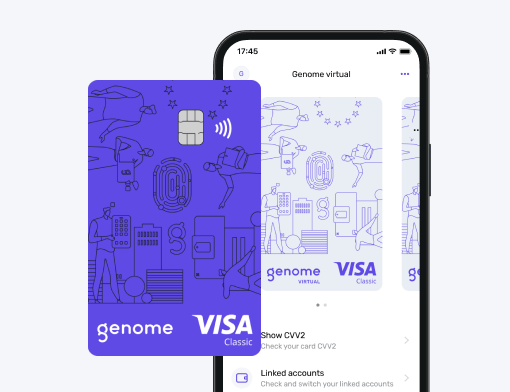
We will be introducing card payment processing for merchants soon, allowing customers from around the world to pay you if they use Mastercard or Visa cards. Our merchant accounts will also allow a multi-currency feature for card payments, so you can accept funds in EUR, USD, and GBP.
Because card declines happen even with the best acquirers, we currently offer instant bank payments via Open Banking and SEPA Instant as a European account-to-account payment option, not just a backup. Genome’s instant bank payments use Open Banking for payment initiation, with SEPA Instant used for instant transfer and settlement when available.
For checkout itself, we provide a hosted payment page with a payment flow built to comply with PSD2 requirements you can launch through a simple integration link. Genome is PCI DSS compliant, and the hosted setup reduces the merchant’s PCI DSS burden, with a clean checkout flow.
Red flags to watch out for in acquiring contracts
If you’re serious about choosing a merchant acquirer / a PSD2-compliant
payment gateway that’s on par with you, watch out for these red flags before signing.
Hidden cross-border markups and multi-currency conversion traps
Some acquirers support only a limited number of settlement currencies, which can mean your funds need to be converted before payout, with an FX fee or markup applied.
Never assume that a European-based acquirer gives you the same prices for every European or international card. Ask if there is separate pricing for EEA consumer cards, commercial cards and cards issued outside the EEA (for example, UK- or US-issued cards). Card type and region can affect interchange and overall processing costs.
Long-term lock-in clauses and steep early termination fees
A three-year contract with a steep early termination fee is one possible contract structure. Other providers offer shorter-term or month-to-month agreements. It’s fine if you know what you are doing and what provider you really want.
A month-to-month agreement is not automatically better, but a long contract should provide a clear benefit in return for the commitment.
Poor visibility into failed payments
Not exactly a red flag, but something to consider: a provider that shows only “payment declined” is giving too little information.
Your dashboard should ideally expose transaction status, decline reasons, authorization performance, chargebacks, refunds, settlements, and reserves.
That data lets you distinguish an issuer decline from a 3DS failure, fraud-rule rejection, technical timeout, or unsupported card.
Select the right European acquiring partner with Genome
Choosing a merchant acquirer in the EEA comes down to four things: transparent EEA payment processing fees, settlement speed for merchants you can plan around, reasonable merchant rolling reserves terms, and a security setup that doesn’t tank your authorization rate.
Get straight answers to the questions above, read the reserve and termination clauses twice, and don’t accept a non-transparent blended rate.
Apply for a business wallet and merchant account inside Genome, accept instant bank payments via Open Banking and SEPA Instant where available (with card payment processing coming soon), and access a wide range of other financial services vital for growing your business.
Open a Genome merchant account and see the merchant pricing in writing before you commit to anything.