

Taking your company to the global stage is an incredible milestone. Finding customers in different countries, working with international partners, and entering new regions mean your brand is scaling successfully. But as your customer base expands, your financial operations must evolve too.
When businesses first start handling international sales, they focus heavily on how to send money out to suppliers or remote teams. However, as transaction volumes grow, many operational managers realize that the way they collect money matters just as much. Managing global payments for business requires a system that is fast, transparent, and completely organized.
Unfortunately, many standard payment tools and traditional banking setups do not always offer companies their own unique account coordinates. Instead, they rely on shared configurations that can slow down your cash flow and create massive tracking challenges for your accounting team.
That’s why many digital businesses nowadays upgrade to a dedicated business IBAN. Having your own individual bank details is one of the important steps in establishing a stable cash flow, protecting your professional reputation, and ensuring your incoming revenue arrives without unnecessary delays.
The structural headache of shared or pooled corporate accounts
When you sign up for a basic corporate card or a digital payment aggregator, you might assume you are getting an independent account. However, behind the scenes, many fintech providers and traditional payment processors place multiple companies into a single, massive pooled account. To distinguish your incoming wire transfers from those of thousands of other businesses, the provider relies entirely on a unique reference code that your customer must type into their banking app.
While this setup works fine for small startups, it quickly becomes an operational bottleneck as you scale. Let’s look at the real-world operational problems this shared structure creates.
The chaos of manual reference codes and payment reconciliation issues
When you send invoices to clients or partners abroad, you expect them to follow the standard payment procedures. But mistakes happen: busy accounting teams may miss the reference field, enter the invoice number into the wrong field, or miss some details.
When this happens in a pooled account structure, the money still arrives at the payment provider, but the system has no idea who it belongs to. The transfer gets stuck in a financial holding pattern. Your team is forced to deal with frustrating payment reconciliation issues, spending days digging through statements, cross-referencing values, and chasing customer support lines to prove the money belongs to your company. Instead of learning how to streamline incoming payments, your staff wastes valuable hours on manual administrative tracking.
Unpredictable processing holds and shared regulatory risks
In a pooled account setup, you are sharing a financial ecosystem with hundreds of other companies. It creates a shared compliance risk that is entirely out of your control.
If another business using that same pooled account triggers an automated fraud filter, handles a suspicious transfer, or faces an unexpected compliance audit, the regulatory authorities or intermediate banks can place a temporary hold on the entire master account. Even when your business follows all the rules, incoming payments can still be delayed by compliance checks. It can disrupt your cash flow and make it harder to manage daily operations.
Open an account
in Genome online
Damaging your professional credibility with major B2B clients
When you work with major enterprise clients or large corporate networks, their legal and compliance teams look closely at payment parameters. If you send them an invoice where the ultimate beneficiary bank details show the name of a third-party payment company rather than your official legal corporate name, it sets off internal security red flags.
Business clients expect the business bank account receiving their payment to clearly belong to the company named in the contract. Shared bank details can make your business look less established and may delay invoice approval while the client verifies the payment information.
The operational benefits of having individual bank details
Upgrading your corporate infrastructure to an independent layout completely changes how your back office operates. Having your own dedicated business IBAN removes the intermediate layers between you and your international clients.
Shared accounts vs. dedicated IBAN infrastructure
Feature comparison | Shared pooled accounts (high friction) | Dedicated business IBAN (streamlined) |
Account ownership | Your business shares a master account identity with other brands. | Your unique identifier is tied strictly to your official corporate name. |
Payment tracking | Relies entirely on clients typing reference codes correctly. | Transfers route automatically based on unique account coordinates. |
Reconciliation flow | Manual and slow; prone to human data-entry errors. | Automated tracking; incoming funds match instantly to client profiles. |
Brand professionalism | Invoices show a payment aggregator’s name as the beneficiary. | Invoices show your legal company name across all global bank routes. |
Automated bookkeeping and immediate inflow matching
With a dedicated IBAN, you do not need to rely on payment reference codes. Each transfer is linked directly to your business, making it easier to identify and reconcile. You can also connect the account to your accounting software to streamline incoming payments, match transfers with invoices, and keep track of your cash flow.
Complete control over brand identity on multi-region invoices
With individual bank details, your company appears as the legal beneficiary when an international partner sends a transfer. Thanks to this, your global payments for business get verified much easier, and you, in turn, reduce compliance issues and help present your business as professional and reliable.
Streamline your global transactions with Genome
If you are ready to move away from shared financial setups and want a clean, modern alternative to old-school banking systems, Genome provides the exact digital tools built for international operations.
Genome functions as a premier business bank account alternative designed to clear away onboarding paperwork and help expanding businesses claim full control over their finances. Inside a single, intuitive online dashboard, Genome allows your company to open a secure multi-currency business account under your own legal name.
With Genome, you get a unique, dedicated business IBAN right the moment your business wallet is available! To get a business wallet, you can start the onboarding right away – completely online. Whether your business is accepting funds from European partners or digital selling platforms, having independent coordinates allows you to streamline incoming payments and completely eliminate traditional payment reconciliation issues.
With our IBAN, you get access to SEPA Instant and Credit Transfers – perfect for payments across Europe! In addition, if your company is eligible, you can unlock international SWIFT transfers. These are available for over 160 destinations and in 12 currencies (USD, GBP, EUR, PLN, CHF, JPY, CAD, CZK, HUF, SEK, AUD, and DKK). Moreover, you can open multi-currency accounts in these currencies.
Open an account
in Genome online
How to structure your dedicated accounts to optimize global cash flow
Once you transition your company to a separate banking identifier, you can apply a few basic operational best practices to keep your global cash flow as efficient as possible.
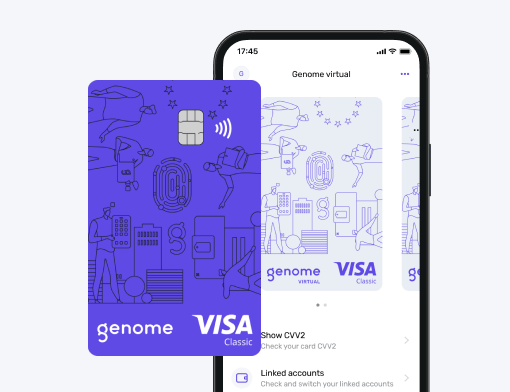
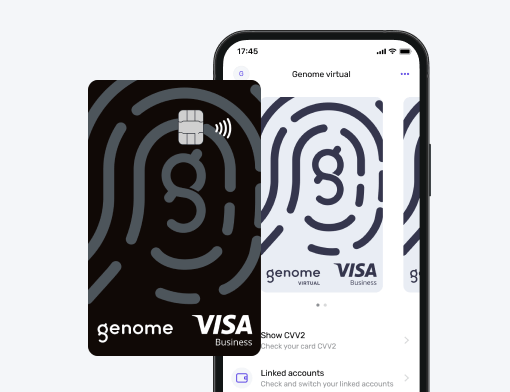
Separate your revenue from your team’s daily expenses: To maximize corporate security, use your main dedicated business IBAN solely as a receiving vault for incoming client payments. When you need to fund team tools, traveling executives, or digital marketing campaigns, manually push specific amounts from your main balance onto secondary virtual cards or separate accounts. For instance, inside Genome, you have your main EUR IBAN account and can add more accounts in EUR and various currencies. You can also link your accounts to physical and virtual Visa cards in EUR, USD, GBP, PLN, CHF, CZK, HUF, SEK, and DKK.
Use local currency routing options: When setting up your corporate portal, make sure your incoming transfers align with your account balances. By setting up a multi-currency business account that holds distinct balances in different currencies, you can instruct your clients to pay into the specific wallet that matches their local currency. Thanks to this, your company can avoid unexpected currency conversion fees when the payment arrives.
Conclusion: take ownership of your global transactions with Genome
As your business grows, your financial tools need to match your operational scale. Relying on shared pooled profiles or manual reference tracking slows down your administrative team, increases the risk of accounting errors, and compromises your corporate credibility with enterprise partners.
Upgrading to a professional, independent setup gives your business the security, speed, and visibility required to scale smoothly. Moving to a modern business bank account alternative ensures your back office runs efficiently, leaving your team free to focus on growth instead of chasing missing invoices.
Take full ownership of your international footprint and protect your brand identity. Open a multi-currency business account with Genome online today, secure your own dedicated business IBAN, and give your company the individual bank details it needs to handle global payments for business with absolute clarity and ease.