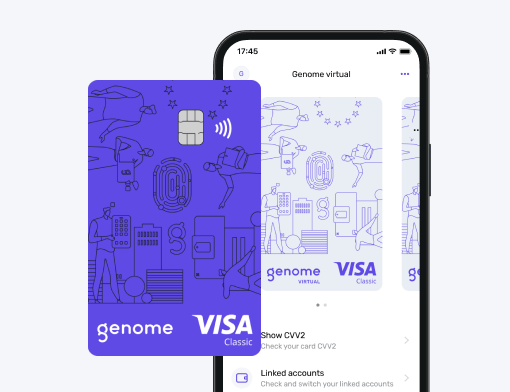
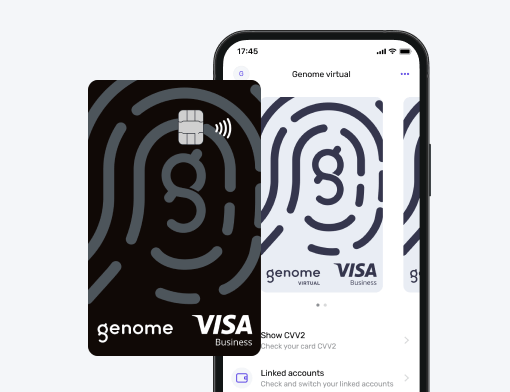


We made July feel international at Genome! Our team has provided many practical guides on various financial topics for companies that conduct operations abroad.
For instance, how they can manage payments more efficiently and support growth across new markets.
We shared practical guides for online platforms, SaaS companies, digital agencies, and other businesses. Read on to discover the main insights!
Choosing a business account for international transfers
International companies need more than a basic account for receiving and sending money. We are talking about multi-currency support, destination-appropriate payment networks, and transfer destinations required for the company’s everyday operations.
Our guide to choosing a business account in Europe explains what companies should consider when comparing corporate accounts.
Multi-currency accounts with access to currencies you require, transparent exchange conditions, reliable transfer options, and access to both European and international payment rails are among the main points to review. A well-suited business account from a platform like Genome can help a company manage cross-border payments from one platform instead of relying on several disconnected providers.
Automating mass payroll and supplier payments
Making a few transfers manually is manageable. But as a company hires more employees, works with more contractors, or expands its supplier network, entering every payment separately becomes increasingly time-consuming.
Our guide on how to automate high-volume payouts explains how batch transfers and payout APIs can reduce repetitive work and support growing payment volumes.
Genome business clients can upload a single file to process up to 3,000 batch transfers at once. Companies with more advanced payment workflows can also connect their internal systems to Genome through a payout API, helping them manage large numbers of B2B and B2C payments more efficiently.
Open an account
in Genome online
Why global companies need a dedicated business IBAN
Receiving international payments can become difficult when a company relies on shared or pooled account details. One of the ways to overcome this issue completely is having a dedicated IBAN.
A dedicated business IBAN gives a company individual account details that can be shared with customers, suppliers, and business partners.
Thanks to the IBAN, the incoming payments are easier to identify, and businesses can maintain clearer financial records. It can also improve the company’s professional image when working with international clients who expect payments to be sent directly to an account registered in the business’s name.
Reducing currency exchange costs in international operations
Working internationally often means receiving revenue, paying suppliers, and covering business expenses in several currencies. An important thing here is to have access to multiple payment destinations as well. However, when it comes to different currencies, you need to keep currency conversion in mind. Without the right setup, repeated conversions, exchange-rate markups, and additional fees can gradually reduce your margins.
We prepared a guide to currency exchange for businesses that explains where unnecessary FX costs can appear and how companies can manage them more effectively.
One practical approach is to use multi-currency accounts. Businesses can receive and hold funds in different currencies and convert them when necessary instead of automatically exchanging every incoming payment.
Helping e-learning platforms grow across borders
Selling courses internationally gives educational platforms access to a much larger audience. However, foreign card declines, unfamiliar checkout processes, and currency conversion can create friction at the final purchase stage.
Our team elaborated on how merchant accounts for e-learning platforms can support cross-border digital sales. Local currency pricing, familiar payment methods, and simple checkout pages can make enrollment more convenient for international students.
We also covered how instant bank payments and hosted payment pages can help platforms offer a smoother and more secure payment experience while reducing the technical work required from their teams.
Reducing payment-related churn for SaaS companies
SaaS business models can face quite a few issues when it comes to client payments. For instance, customers can lose access to a service when their card expires, a payment is declined, or their billing details are no longer valid.
In July, we explained how merchant accounts for SaaS businesses can help companies manage global subscription billing and reduce involuntary churn.
We covered payment retries, dunning workflows, decline code analysis, and alternative payment methods. Our team also elaborated on how Pay by Bank allows customers to pay directly from their bank accounts, avoiding many of the issues associated with expired or replaced cards.
Managing international supplier payments safely
Paying suppliers abroad involves more than simply sending the amount shown on an invoice. Currency conversion, intermediary bank charges, compliance checks, and incorrect payment details can lead to delays or result in the supplier receiving less than expected.
Our article about cross-border B2B transactions explains how companies can organize international supplier payments more reliably.
We covered the importance of checking payment details, understanding SWIFT fees, choosing suitable currencies, and planning transfers before important production or shipping deadlines. As we have recently expanded our SWIFT payment destinations to 161 countries and territories, this guide will certainly be useful to businesses that utilize this service.
Open an account
in Genome online
Organizing digital agency expenses with virtual cards
Digital agencies often manage advertising budgets, software subscriptions, travel costs, and other expenses for multiple teams and clients. Using the same corporate card for all these payments can certainly cause issues. This is where virtual cards come in!
Learn how virtual business cards can help agencies separate expenses by client, employee, platform, or advertising campaign.
Teams can issue separate cards (hundreds of them, if needed), set spending limits, and track expenses in one place. They can also block one card without affecting the others.
Did you miss Genome’s previous month in review? Don’t forget to check the June updates! We announced the expansion of SWIFT business transfers to 161 countries and territories, welcomed Canadian businesses for onboarding, and shared guides on Pay by Bank for subscriptions, virtual cards for ad spend, hosted and self-hosted payment pages, and FX risk in global e-commerce.